Table of Contents
- What Is a Currency Strength Meter?
- Why Currency Strength Matters in Forex Trading
- How a Currency Strength Meter Works
- Currency Strength vs Currency Pair Analysis
- Example of Using a Currency Strength Meter
- Benefits of Using a Currency Strength Meter
- Limitations of a Currency Strength Meter
- Take control of your trading future
- How Traders Can Use Currency Strength with Market Structure
- Currency Strength and Trend Trading
- Currency Strength and Pullback Trading
- Currency Strength and Breakouts
- Currency Strength and Reversals
- Common Mistakes Traders Make with Currency Strength Meters
- How Automated Trading Tools Can Support Market Analysis
- Final Thoughts
- Disclaimer
What Is a Currency Strength Meter?
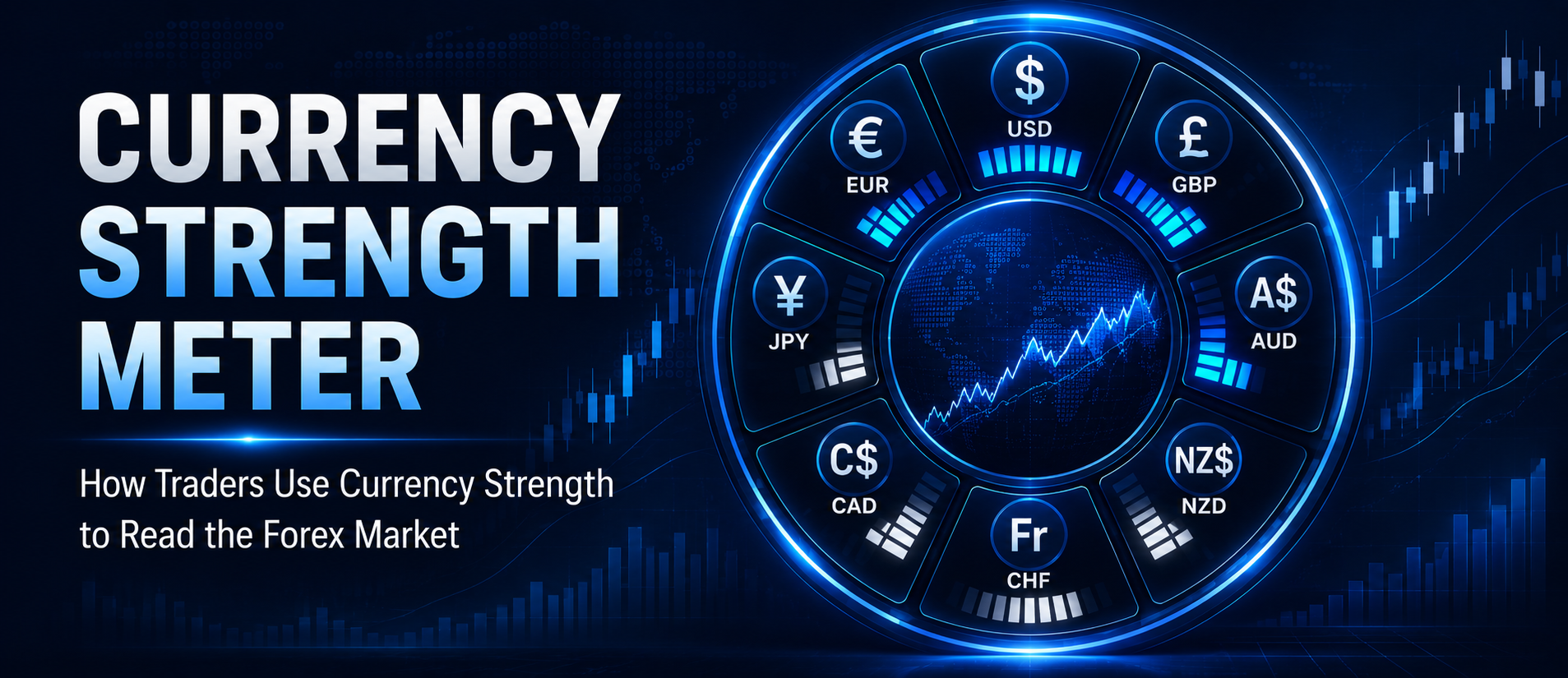
A currency strength meter is a trading tool that helps traders compare the relative strength or weakness of major currencies in the forex market.
Instead of looking at only one currency pair, a currency strength meter looks at multiple pairs and shows which currencies are gaining strength and which currencies are losing strength.
For example, instead of only checking EUR/USD, a trader can look at the euro, US dollar, British pound, Japanese yen, Australian dollar, Canadian dollar, Swiss franc, and New Zealand dollar as separate currencies.
This can make market analysis easier because forex trading is always about comparing one currency against another.
When a trader buys EUR/USD, they are not only buying the euro. They are also selling the US dollar. That means the trade depends on both euro strength and dollar weakness.
A currency strength meter helps traders see that relationship more clearly.
Why Currency Strength Matters in Forex Trading
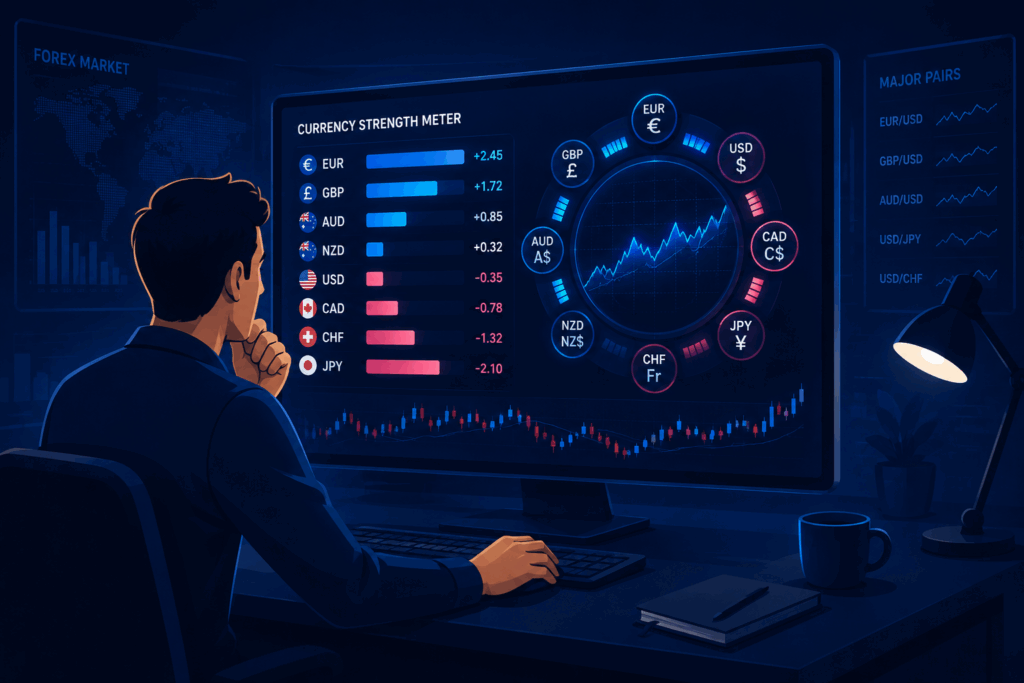
Currency strength matters because forex pairs move based on the relationship between two currencies.
A strong currency can rise against weaker currencies. A weak currency can fall against stronger currencies. When traders understand this relationship, they can make better decisions about which pairs may offer cleaner trading opportunities.
For example:
- If the euro is strong and the US dollar is weak, EUR/USD may move higher.
- If the British pound is weak and the Japanese yen is strong, GBP/JPY may move lower.
- If both currencies are strong, the pair may move sideways or become choppy.
- If both currencies are weak, the pair may also lack clear direction.
This is why many traders use currency strength as part of their market analysis.
It helps them avoid guessing and gives them a broader view of what is happening across the forex market.
How a Currency Strength Meter Works
A currency strength meter usually calculates currency strength by comparing price movement across multiple currency pairs.
For example, to measure the strength of the US dollar, the tool may analyze pairs such as:
- EUR/USD
- GBP/USD
- USD/JPY
- USD/CAD
- AUD/USD
- NZD/USD
- USD/CHF
The meter then estimates whether the dollar is gaining or losing strength compared to other major currencies.
Different tools use different formulas. Some use price change over a certain period. Some use moving averages. Some use momentum indicators. Others may use a combination of technical data.
Because of this, not every currency strength meter will show the exact same result.
That is important to understand.
A currency strength meter should not be treated as a perfect signal generator. It is better used as a market reading tool.
Currency Strength vs Currency Pair Analysis
Many beginner traders focus only on one chart at a time.
They may open EUR/USD, look at support and resistance, and decide whether to buy or sell.
That can work, but it can also create blind spots.
A currency pair chart only shows the relationship between two currencies. A currency strength meter gives a wider view.
For example, EUR/USD may be moving higher. But why?
It could be because:
- The euro is strong.
- The US dollar is weak.
- Both are happening at the same time.
- The move is temporary and not supported by broader strength.
A currency strength meter can help traders understand the reason behind the movement.
This can be useful because stronger setups often happen when one currency is clearly strong and the other is clearly weak.
Example of Using a Currency Strength Meter
Let’s say a trader checks the market and sees this:
- EUR is strong.
- GBP is strong.
- USD is weak.
- JPY is weak.
This tells the trader that euro and pound pairs against the dollar or yen may deserve attention.
Possible pairs could include:
- EUR/USD
- GBP/USD
- EUR/JPY
- GBP/JPY
The trader can then open the charts and look for confirmation.
They may check:
- Market structure
- Trend direction
- Support and resistance
- Breakouts
- Pullbacks
- Price action
- Risk-to-reward setup
The currency strength meter gives the trader a starting point. The chart still needs to confirm the trade idea.
Benefits of Using a Currency Strength Meter
A currency strength meter can help traders in several practical ways.
It Saves Time
Instead of checking many pairs one by one, traders can quickly see which currencies are strong or weak.
This helps narrow down the watchlist.
It Helps Identify Better Pair Selection
Pair selection matters in forex trading.
A trader may find cleaner movement when trading a strong currency against a weak currency.
It Gives a Broader Market View
Forex is connected.
A currency strength meter helps traders see the bigger picture instead of focusing on one chart only.
It Can Help Avoid Choppy Pairs
When two currencies are showing similar strength, the pair may lack direction.
A currency strength meter can help traders avoid pairs that may be more likely to move sideways.
It Supports Confirmation
The tool can support a trading idea by showing whether the currency strength agrees with the chart setup.
Limitations of a Currency Strength Meter
A currency strength meter can be useful, but it is not perfect.
Traders should understand its limitations before relying on it.
It Can Lag Behind the Market
Many meters use past price data. That means they may react after a move has already started.
Different Meters Can Show Different Results
There is no single universal calculation method.
One tool may show the euro as strong, while another may show a more neutral reading.
It Does Not Replace Risk Management
Even if a currency looks strong, the trade can still fail.
Every trade needs proper risk control.
It Does Not Predict the Future
A currency strength meter shows current or recent strength. It does not guarantee what will happen next.
It Should Not Be Used Alone
The best use of a currency strength meter is as part of a broader trading process.
It should be combined with chart analysis, market structure, price action, and a clear trading plan.
Take control of your trading future
Supercharge your trading with our expert advisors. Start your journey today!
How Traders Can Use Currency Strength with Market Structure
Market structure helps traders understand whether price is trending, ranging, breaking out, pulling back, or reversing.
Currency strength can support this analysis.
For example, if EUR/USD is in an uptrend and the currency strength meter shows euro strength and dollar weakness, the trader may have a stronger case for looking at bullish setups.
If the chart shows an uptrend but the meter shows the euro losing strength, the trader may be more cautious.
This does not mean the trade is invalid. It simply means the trader has more information to consider.
Currency Strength and Trend Trading
Trend traders often look for strong directional movement.
A currency strength meter can help them find currencies that are leading the market.
For example, if the Australian dollar is strong across multiple pairs, traders may look for AUD pairs with bullish structure.
If the Japanese yen is weak across the market, traders may look for pairs where the yen is the quote currency and price is moving higher.
This can help traders focus on pairs that may have stronger momentum.
Currency Strength and Pullback Trading
Pullbacks happen when price temporarily moves against the main trend.
A currency strength meter can help traders decide whether a pullback is just a temporary pause or a possible warning sign.
For example, if GBP/USD is in an uptrend and the pound remains strong while the dollar remains weak, a pullback may offer a possible continuation setup.
However, if the pound starts weakening and the dollar starts strengthening, the pullback may become more dangerous.
This is why traders often use currency strength as an extra layer of confirmation.
Currency Strength and Breakouts
Breakout trading involves looking for price to move beyond a key level.
A breakout may have a better chance of continuation when currency strength supports the move.
For example, if EUR/JPY breaks above resistance while the euro is strong and the yen is weak, the breakout may look more convincing.
If the breakout happens while both currencies are neutral, the trader may want more confirmation.
Currency strength can help traders filter breakout setups.
Currency Strength and Reversals
Reversal trading is more difficult because traders are trying to catch a change in direction.
A currency strength meter can help traders notice early changes in market pressure.
For example, if USD/CAD has been rising but the US dollar starts losing strength while the Canadian dollar starts gaining strength, traders may begin watching for a possible reversal.
This does not mean they should enter immediately.
They still need chart confirmation, such as:
- Break of structure
- Failed breakout
- Rejection from a key level
- Momentum shift
- Lower highs or higher lows
Currency strength helps traders notice when conditions may be changing.
Common Mistakes Traders Make with Currency Strength Meters
Many traders use currency strength meters incorrectly.
Here are some common mistakes.
Treating It Like a Buy or Sell Signal
A currency strength meter is not a complete strategy.
It does not automatically tell traders when to enter or exit.
Ignoring the Chart
Currency strength should be checked with price action.
The chart still matters.
Entering Too Late
Sometimes a currency already made a large move before the meter shows strong readings.
Entering late can increase risk.
Using Too Many Tools
Some traders add too many indicators and make analysis confusing.
A currency strength meter works best when used simply.
Forgetting About News
Economic news can quickly change currency strength.
Traders should be aware of major events that may affect volatility.
How Automated Trading Tools Can Support Market Analysis
Many traders use tools to save time, organize information, and improve consistency.
A currency strength meter can be part of that process.
Auvoria Prime focuses on helping traders access technology that can support their trading journey. Tools, automation, education, and structured systems can help traders approach the market with more clarity.
However, tools should be used responsibly.
No tool removes risk. No software guarantees profit. Trading still requires patience, discipline, and risk management.

Final Thoughts
A currency strength meter can be a helpful tool for forex traders who want to understand the market more clearly.
It helps traders compare currencies, identify strong and weak combinations, and narrow down possible trading opportunities.
The key is to use it correctly.
A currency strength meter should not replace a trading strategy. It should support one.
When combined with market structure, price action, risk management, and a clear trading plan, currency strength can help traders make more informed decisions.
Forex trading is not about guessing which pair may move next. It is about reading the relationship between currencies and managing risk carefully.
A currency strength meter can make that process easier to understand.
Disclaimer
Trading foreign exchange involves risk and may not be suitable for all individuals. Past performance does not guarantee future results. Auvoria Prime does not guarantee profits or specific trading outcomes. Any tools, software, education, or market information should be used for informational purposes only and should not be considered financial advice. Traders should always perform their own analysis and only trade with funds they can afford to risk.

Best Robo Advisors: A Complete Guide to Automated Investing
Choosing how to invest has become easier than ever thanks to technology. One of the biggest innovations in recent years…

Best Day Trading App: What Traders Should Look for Before
Day trading has become more accessible than ever. With the rise of mobile technology, cloud-based platforms, and real-time market data,…
FGP1 July 2026 Performance Overview
Geographic Restriction & Risk Notice FGP1 is geographically restricted and is not available to U.S. persons or residents. Trading involves substantial…
London Session Forex Time: Everything Traders Need to Know About
The foreign exchange market operates 24 hours a day, five days a week. While trading is possible around the clock,…

FGP1 June 2026 Performance Overview
Geographic Restriction & Risk Notice FGP1 is geographically restricted and is not available to U.S. persons or residents. Trading involves substantial…

AI Stock Trading: How Artificial Intelligence Is Changing the Way
Artificial intelligence is transforming industries around the world, and financial markets are no exception. What once required hours of chart…