Table of Contents
- What Are Trading Hours?
- The Four Major Trading Sessions
- Why Trading Hours Matter
- Take control of your trading future
- The Importance of Session Overlaps
- When Markets Are Most Active
- When Markets Are Less Active
- How Professional Traders Use Trading Hours
- Automated Trading and Market Timing
- Key Factors That Influence Trading Activity
- Choosing the Best Trading Hours
- Managing Risk Across Trading Sessions
- Final Thoughts
- Disclaimer
Understanding trading hours is one of the most important foundations for anyone involved in financial markets. Many beginners focus on strategies, indicators, and entry signals. However, experienced traders often start with a simpler question: When should you trade?
The global financial markets operate almost 24 hours a day. Yet activity is not evenly distributed throughout the day. Certain hours see higher liquidity, stronger price movement, and better trading opportunities. Other periods can be slow, unpredictable, or difficult to trade.
Knowing the difference can significantly improve decision making. In this guide, we explain global trading hours, how market sessions work, when markets are most active, and why timing plays a key role in trading performance.
What Are Trading Hours?
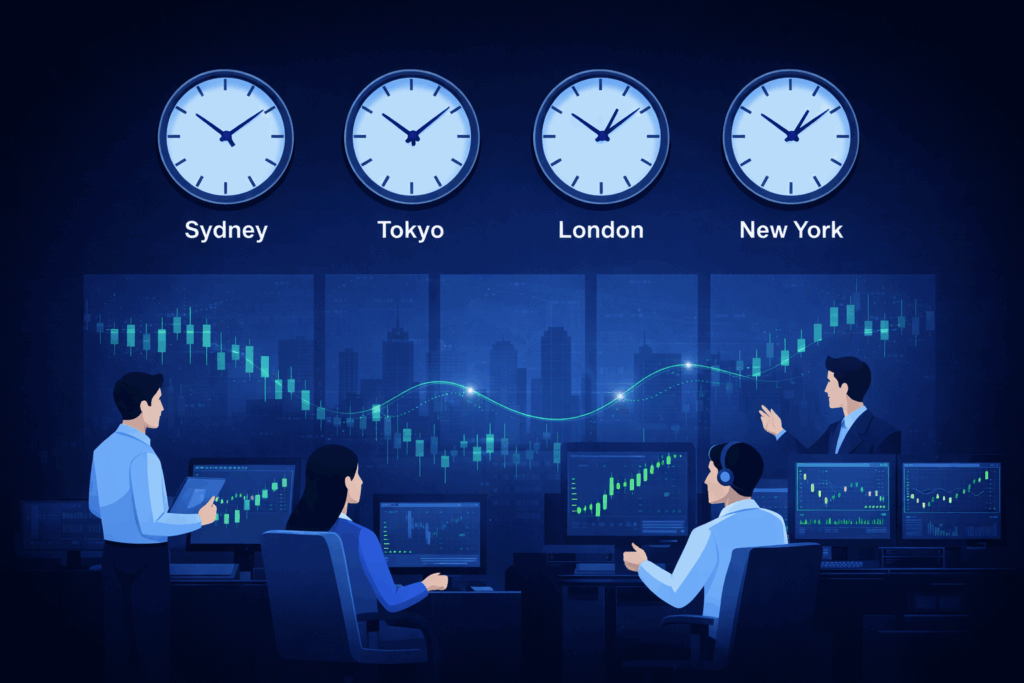
Trading hours refer to the specific times when financial markets are open and available for trading. Each major financial center operates during its own business hours. Because the world spans multiple time zones, markets open and close at different times throughout the day.
In the forex market, trading occurs continuously during the week. The market opens late Sunday evening and closes late Friday evening. During this period, traders can buy and sell currencies almost around the clock.
However, activity shifts between different financial centers. As one region closes, another opens. This rotation creates what traders call market sessions.
These sessions help define when trading volume is highest and when price movements are most significant.
The Four Major Trading Sessions
Global markets revolve around four primary trading sessions. Each session corresponds to a major financial hub.
Sydney Session
The trading week begins with the Sydney session. This session opens the global forex market after the weekend.
Although it marks the beginning of the trading week, Sydney generally has lower trading volume compared to other sessions. Price movements can be relatively calm.
However, this session still plays an important role. It sets the early tone for market sentiment and allows traders in the Asia-Pacific region to participate in the market.
Tokyo Session
The Tokyo session represents the main Asian trading period. Japan is one of the world’s largest financial centers, and this session introduces more liquidity compared to Sydney.
Currency pairs involving the Japanese yen often see stronger activity during this time. Economic releases from Japan and nearby economies can influence price movements.
Even so, volatility tends to remain moderate compared to later sessions in the trading day.
London Session
The London session is widely considered the most important trading session in the global market.
London has historically been one of the world’s largest financial centers. A significant portion of daily forex trading volume flows through European institutions during this period.
Because of the high liquidity, many traders prefer the London session. Spreads are typically tighter, and price movements are more reliable.
Major economic reports from Europe also tend to be released during this session, which can create increased volatility.
New York Session
The New York session overlaps with the London session for several hours. This overlap is often the most active trading period of the day.
During this time, both European and American traders participate simultaneously. The combined liquidity can create strong price movements.
Economic data from the United States often drives market volatility during this session. News related to interest rates, inflation, employment, and economic growth can influence global markets.
Once London closes, activity usually begins to slow until the Asian sessions reopen.
Why Trading Hours Matter
Many traders underestimate the impact of trading hours. However, timing can influence nearly every aspect of trading performance.
Here are several reasons why trading hours matter.
Liquidity
Liquidity refers to how easily assets can be bought or sold without causing large price changes. During high-liquidity periods, orders are filled quickly and spreads tend to be smaller.
High liquidity usually occurs when multiple trading centers are active at the same time.
Volatility
Volatility measures how much price moves within a given period.
Some traders prefer high volatility because it creates opportunities for larger profits. Others prefer calmer conditions where price moves more slowly.
Trading hours directly affect volatility. Major market sessions often generate stronger price movement.
Market Efficiency
When markets are active, price discovery tends to be more efficient. This means prices respond more quickly to new information.
In slower trading periods, prices may move erratically or lack clear direction.
Strategy Performance
Many trading strategies perform better during specific market conditions.
For example:
Trend strategies often perform well during high-volume sessions.
Range strategies may work better during quieter periods.
Understanding trading hours helps traders align their strategy with the right market conditions.
Take control of your trading future
Supercharge your trading with our expert advisors. Start your journey today!
The Importance of Session Overlaps
One of the most important concepts in global trading hours is session overlap.
This occurs when two major market sessions operate at the same time. Overlap periods often produce the highest trading volume of the day.
The most significant overlap happens between the London and New York sessions.
During this time, both European and American traders are active. Banks, institutions, hedge funds, and retail traders all participate simultaneously.
This combination creates strong liquidity and frequent price movement.
Many traders consider this period the most favorable time to trade.
When Markets Are Most Active
Although markets operate nearly 24 hours a day, activity tends to concentrate during specific windows.
The most active trading hours usually occur during:
London session opening
London and New York overlap
Major economic announcements
These periods often generate the largest price movements.
For traders who rely on volatility, these hours may provide more opportunities.
However, increased activity also means increased risk. Rapid price changes can lead to unexpected outcomes.
When Markets Are Less Active
Some trading hours experience much lower market activity.
This typically occurs during:
Late U.S. afternoon
Early Sydney session
Periods between major sessions
During these hours, markets may move slowly or remain within narrow ranges.
For certain strategies, this environment can still be useful. However, liquidity may be lower and spreads may widen.
Traders should be aware of these conditions before placing trades.
How Professional Traders Use Trading Hours
Professional traders often structure their schedules around specific market sessions.
Rather than watching the market continuously, they focus on the periods where their strategy performs best.
For example:
Day traders often focus on the London and New York sessions.
Scalpers may trade during high-liquidity periods when spreads are tight.
Swing traders may analyze markets outside peak hours but execute trades during active sessions.
By aligning their approach with trading hours, traders can improve efficiency and reduce unnecessary screen time.
Automated Trading and Market Timing
Automated trading systems and algorithmic strategies can also benefit from understanding trading hours.
Some systems perform best during trending conditions, which often occur during high-volume sessions.
Others may focus on quieter periods where price remains within defined ranges.
Automation allows strategies to operate consistently without emotional decision making. However, timing still plays an important role in performance.
Developers often design trading algorithms to operate during specific sessions where the strategy historically performs best.
Key Factors That Influence Trading Activity
Several factors influence how active markets are during different trading hours.
Economic Data Releases
Major economic announcements often create increased volatility.
These events frequently occur during the London or New York sessions.
Institutional Participation
Large financial institutions operate primarily during business hours in major financial centers.
Their participation contributes to market liquidity.
Global News Events
Political developments, economic decisions, and global events can influence market activity at any time.
However, reactions tend to be strongest when markets are fully active.
Choosing the Best Trading Hours
The best trading hours depend on individual goals and strategies.
Some traders prefer highly active sessions with strong volatility. Others prefer slower markets where price moves gradually.
When choosing trading hours, traders should consider:
Their strategy
Their risk tolerance
Their available trading time
Their preferred currency pairs or assets
Testing strategies during different sessions can help determine which periods provide the most consistent results.
Managing Risk Across Trading Sessions
Trading during active hours can offer more opportunities, but it also introduces higher risk.
Rapid price movement can lead to larger losses if trades are not managed carefully.
Risk management is essential regardless of trading hours. This includes setting appropriate position sizes, using stop losses, and avoiding emotional decision making.
A disciplined approach helps traders navigate different market conditions throughout the trading day.
Final Thoughts
Global trading hours shape the rhythm of financial markets. While markets remain open nearly 24 hours a day, activity shifts between different financial centers.
Understanding when markets are most active helps traders improve timing, reduce uncertainty, and align their strategies with favorable conditions.
Whether trading manually or using automated systems, recognizing the importance of trading hours can play a significant role in long-term performance.
By studying market sessions and adapting to changing activity levels, traders can approach the markets with greater awareness and consistency.
Disclaimer
Trading financial markets involves risk. Past performance does not guarantee future results. The information provided in this article is for educational purposes only and should not be considered financial advice. Traders should conduct their own research and consider their financial situation and risk tolerance before participating in any trading activity.
FGP1 August 2026 Performance Overview
Geographic Restriction & Risk Notice FGP1 is geographically restricted and is not available to U.S. persons or residents. Trading involves substantial…

Best Robo Advisors: A Complete Guide to Automated Investing
Choosing how to invest has become easier than ever thanks to technology. One of the biggest innovations in recent years…
Best Day Trading App: What Traders Should Look for Before
Day trading has become more accessible than ever. With the rise of mobile technology, cloud-based platforms, and real-time market data,…
FGP1 July 2026 Performance Overview
Geographic Restriction & Risk Notice FGP1 is geographically restricted and is not available to U.S. persons or residents. Trading involves substantial…
London Session Forex Time: Everything Traders Need to Know About
The foreign exchange market operates 24 hours a day, five days a week. While trading is possible around the clock,…

FGP1 June 2026 Performance Overview
Geographic Restriction & Risk Notice FGP1 is geographically restricted and is not available to U.S. persons or residents. Trading involves substantial…