Table of Contents
- What Are Stock Brokers?
- Why Choosing the Right Broker Matters
- What Makes the Top Stock Brokers Stand Out?
- Transparent Fees and Pricing
- Market Access
- Platform Reliability
- Fast and Clear Order Execution
- User-Friendly Trading Platforms
- Take control of your trading future
- Mobile Trading Features
- Charting and Analysis Tools
- Research and Market Insights
- Education for Beginners
- Demo Accounts and Practice Trading
- Security and Account Protection
- Customer Support
- Risk Management Tools
- Margin and Leverage
- Beginner Traders Versus Active Traders
- Long-Term Investors Versus Short-Term Traders
- How Automation Is Changing Broker Platforms
- The Role of AI in Modern Trading
- Red Flags to Watch For
- How to Compare Top Stock Brokers
- Why the “Best” Broker Is Personal
- Final Thoughts
- Disclaimer
Choosing from the top stock brokers can feel overwhelming. There are many platforms, account types, tools, fees, apps, and trading features to compare. Some brokers focus on beginners. Others are built for active traders. Some offer strong research tools, while others focus on fast execution, mobile trading, or low-cost access to markets.
The truth is simple. There is no single broker that is best for every trader.
The right broker depends on your goals, experience, trading style, risk tolerance, and the markets you want to access. A long-term investor may need different tools than a short-term trader. A beginner may value education and simplicity. An experienced trader may care more about charting, automation, spreads, order types, and platform reliability.
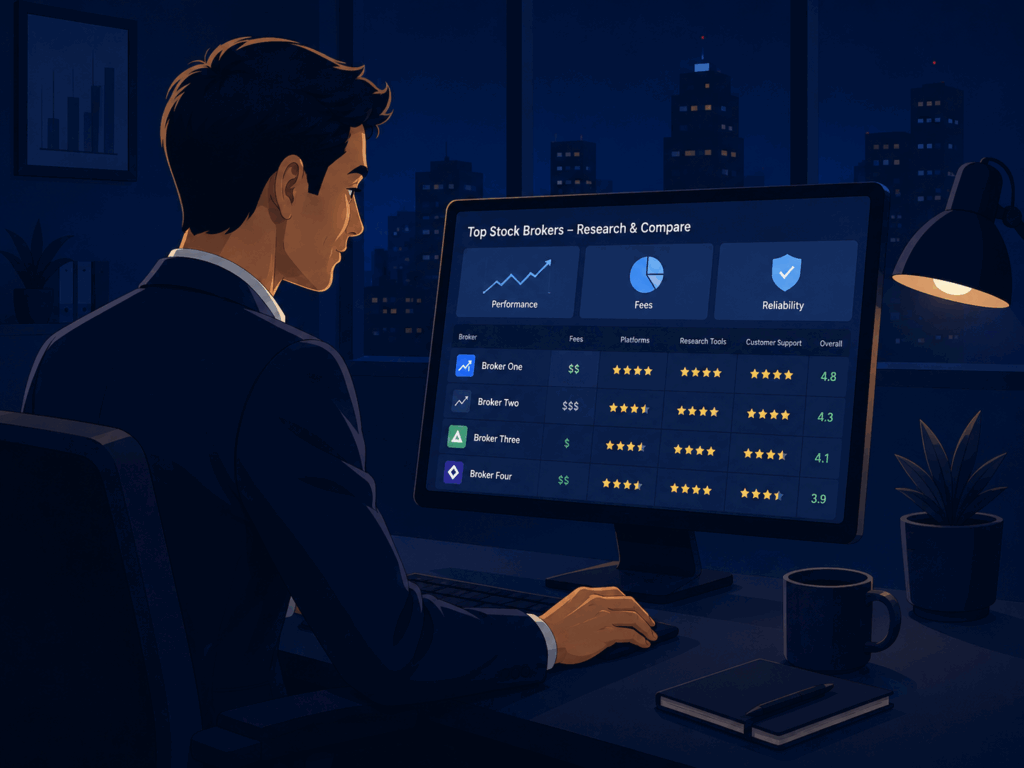
This guide explains what top stock brokers usually have in common. It also shows how traders can compare platforms before opening an account.
What Are Stock Brokers?
A stock broker is a company or platform that allows people to buy and sell stocks and other financial instruments.
Modern brokers usually operate online. Most provide desktop platforms, mobile apps, research tools, charts, account dashboards, and order management features.
Depending on the broker, traders may be able to access:
- Stocks
- ETFs
- Options
- Bonds
- Mutual funds
- Forex
- Commodities
- Indices
- Cryptocurrencies
- CFDs, where available
Not every broker offers the same markets. This is why comparison matters.
A trader should first decide what they want to trade. Then they can look for a broker that supports those markets clearly and reliably.
Why Choosing the Right Broker Matters
Your broker is more than a place to place trades.
It affects your full trading experience. A strong broker can make trading smoother, faster, and easier to manage. A weak broker can create frustration, confusion, or unnecessary costs.
The broker you choose may affect:
- How fast your orders are executed
- What markets you can access
- How much you pay in fees
- Which tools you can use
- How easy it is to manage risk
- How secure your account feels
- How much educational support you receive
For active traders, platform quality matters even more. Fast-moving markets require stable technology, clear pricing, and dependable execution.
What Makes the Top Stock Brokers Stand Out?
The top stock brokers usually share several qualities. They are not only popular. They also provide tools and conditions that support a better trading process.
A strong broker usually offers:
- Transparent pricing
- Reliable trade execution
- Useful trading tools
- Clear market access
- Strong security features
- Good customer support
- Educational resources
- Easy account management
- Mobile and desktop access
These features help traders stay organized and informed.
Transparent Fees and Pricing
Fees can have a major impact on trading results.
Even small costs can add up over time, especially for active traders. Before choosing a broker, traders should understand exactly what they may pay.
Common broker costs may include:
- Commission fees
- Spreads
- Platform fees
- Data fees
- Withdrawal fees
- Currency conversion fees
- Inactivity fees
- Margin interest
- Overnight financing fees
Some brokers advertise low commissions but may charge in other ways. Others offer simple pricing but fewer advanced tools.
The goal is not always to find the cheapest broker. The goal is to find a broker with fair, clear, and transparent pricing.
Market Access
Market access is one of the most important factors when comparing top stock brokers.
A trader should ask:
- Can I trade the assets I want?
- Are the markets available in my region?
- Are trading hours clearly explained?
- Are there restrictions on certain products?
- Does the broker support international markets?
A long-term investor may only need stocks and ETFs. An active trader may want access to stocks, indices, forex, and commodities. A more advanced trader may need options, futures, or margin products.
The best broker for you should match the way you plan to trade.
Platform Reliability
A broker can have great features, but reliability is still essential.
Trading platforms should work smoothly during busy market conditions. If a platform freezes, delays data, or fails during volatility, traders may struggle to manage positions.
A reliable platform should offer:
- Stable login access
- Fast chart loading
- Quick order entry
- Real-time pricing
- Clear account updates
- Minimal downtime
Reliability is especially important for short-term traders. When prices move quickly, every second can matter.
Fast and Clear Order Execution
Order execution is how your trade is processed in the market.
Top stock brokers should make this process clear and efficient. Traders need to know how orders are handled, what order types are available, and whether execution is consistent.
Common order types include:
- Market orders
- Limit orders
- Stop orders
- Stop-loss orders
- Take-profit orders
- Trailing stops
More advanced platforms may also offer conditional orders and bracket orders.
A strong broker gives traders more control over entries, exits, and risk.
User-Friendly Trading Platforms
A good trading platform should be powerful without being confusing.
Beginners need simple navigation. Experienced traders need deeper tools. The best platforms often balance both.
A quality platform should include:
- Clean dashboards
- Easy-to-read charts
- Watchlists
- Account summaries
- Fast order tickets
- Custom layouts
- Simple position tracking
A platform should help traders focus on decisions, not waste time searching for basic tools.
Take control of your trading future
Supercharge your trading with our expert advisors. Start your journey today!
Mobile Trading Features
Mobile trading has become a major part of modern investing.
Many traders now expect their broker to offer a strong mobile app. This does not mean every trade should be placed from a phone. It means traders want flexibility.
A strong mobile app should allow users to:
- Check positions
- View charts
- Place orders
- Set alerts
- Monitor watchlists
- Review account balances
- Read market updates
Mobile apps are useful for monitoring. Desktop platforms may still be better for deeper analysis.
Many traders use both.
Charting and Analysis Tools
Charts help traders understand price movement.
Top stock brokers usually provide charting tools that support both basic and advanced analysis.
Helpful charting features include:
- Multiple timeframes
- Candlestick charts
- Line charts
- Volume indicators
- Trend lines
- Drawing tools
- Moving averages
- Technical indicators
- Price alerts
Good charting does not guarantee better results. However, it can help traders analyze markets more clearly.

Research and Market Insights
Many traders want access to research before making decisions.
Top stock brokers may provide:
- Market news
- Analyst ratings
- Company financials
- Earnings calendars
- Economic calendars
- Stock screeners
- Sector performance data
- Market commentary
Research tools are especially useful for traders who want to understand why a stock may be moving.
For long-term investors, research can help with company analysis. For active traders, it can help with event awareness and trade planning.
Education for Beginners
Education is one area that separates many strong brokers from weaker ones.
Beginners need more than a buy and sell button. They need clear explanations, platform tutorials, and risk guidance.
Useful educational resources include:
- Beginner trading guides
- Video tutorials
- Webinars
- Glossaries
- Strategy explainers
- Risk management lessons
- Demo account support
A broker that supports learning can help users build better habits from the start.
Demo Accounts and Practice Trading
A demo account allows users to practice trading without risking real money.
This can be helpful for beginners. It can also help experienced traders test a platform before funding an account.
Demo accounts can help traders learn:
- How to place orders
- How charts work
- How spreads move
- How positions update
- How risk tools function
- How the platform feels during market hours
A demo account does not fully recreate live trading emotions. Still, it can be a useful first step.
Security and Account Protection
Security should be a major consideration when comparing top stock brokers.
A broker should take account protection seriously.
Important security features include:
- Two-factor authentication
- Strong login protection
- Data encryption
- Secure withdrawals
- Account alerts
- Identity verification
- Clear privacy policies
Traders should also confirm whether the broker is registered or regulated in the relevant region.
Regulation does not remove trading risk. It also does not guarantee profits. But it can provide a more structured environment.
Customer Support
Customer support is often overlooked until something goes wrong.
A broker may look great on the surface, but poor support can create problems when help is needed.
Useful support options may include:
- Live chat
- Email support
- Phone support
- Help center articles
- Platform tutorials
- Account assistance
- Fast response times
Traders should check support availability before opening an account. This is especially important if they trade outside normal business hours.
Risk Management Tools
Risk management is one of the most important parts of trading.
Top stock brokers often provide built-in tools that help traders control exposure.
Common risk tools include:
- Stop-loss orders
- Take-profit orders
- Margin alerts
- Price alerts
- Account balance tracking
- Position size information
- Portfolio exposure views
A broker cannot manage risk for the trader. But it can provide tools that make risk easier to monitor.
Margin and Leverage
Some brokers offer margin or leveraged products.
These tools can increase buying power. They can also increase losses.
Traders should understand the rules before using margin. They should know:
- How margin works
- What interest may apply
- When margin calls can happen
- How losses can increase
- Which products use leverage
- Whether leveraged trading fits their risk profile
Margin is not suitable for everyone. It should be approached carefully.
Beginner Traders Versus Active Traders
Different traders need different brokers.
A beginner may prefer:
- Simple platform design
- Low account minimums
- Educational content
- Demo trading
- Basic charting
- Easy customer support
An active trader may prefer:
- Faster execution
- Advanced order types
- More charting tools
- Market scanners
- Lower active trading costs
- Custom workspaces
- More detailed data
The best broker depends on the trader.
Long-Term Investors Versus Short-Term Traders
Long-term investors and short-term traders also have different needs.
Long-term investors may focus on:
- Low-cost stock and ETF access
- Retirement account options
- Research tools
- Portfolio tracking
- Dividend information
- Long-term planning resources
Short-term traders may focus on:
- Real-time data
- Fast execution
- Low spreads
- Technical analysis tools
- Alerts
- Advanced order management
Before choosing a broker, traders should understand which category they fit into.
How Automation Is Changing Broker Platforms
Technology has changed what traders expect from brokers.
Modern platforms may include automated features such as:
- Watchlist alerts
- Price notifications
- Automated reporting
- Portfolio tracking
- Market scanners
- Strategy tools
- AI-assisted insights
Automation can help traders process information faster. It can also reduce manual workload.
Still, automation does not remove risk. Traders should understand how any automated tool works before relying on it.
The Role of AI in Modern Trading
Artificial intelligence is becoming more common in trading tools.
AI may help platforms organize data, identify patterns, summarize news, or highlight unusual market activity.
AI tools may support:
- Market analysis
- Pattern recognition
- Sentiment tracking
- Trade idea discovery
- Risk alerts
- Portfolio insights
AI should be viewed as a support tool. It should not replace education, planning, or personal responsibility.
Red Flags to Watch For
Not every broker is worth trusting.
Traders should be cautious if a broker:
- Promises guaranteed profits
- Makes unrealistic claims
- Hides fees
- Has unclear withdrawal rules
- Provides poor support
- Lacks transparency
- Uses aggressive sales pressure
- Makes risk seem small
- Offers confusing account terms
A trustworthy broker should be clear about risk, fees, and trading conditions.
How to Compare Top Stock Brokers
A simple comparison process can help traders make better decisions.
Before opening an account, review:
- Regulation and registration
- Available markets
- Trading costs
- Platform reliability
- Mobile app quality
- Charting tools
- Order types
- Research features
- Education
- Customer support
- Risk management tools
- Withdrawal process
This checklist can make the decision easier.
Why the “Best” Broker Is Personal
Many articles rank brokers from best to worst.
That can be useful, but it is not the full story.
A broker that works well for one trader may not fit another. A platform built for active traders may feel too complex for beginners. A beginner-friendly platform may not offer enough depth for advanced users.
The best broker is the one that matches your goals and helps you trade with clarity.

Final Thoughts
The top stock brokers usually offer a combination of reliability, clear pricing, strong tools, market access, education, security, and support.
Before choosing a broker, traders should take time to compare platforms carefully. They should understand their own goals first. Then they can look for a broker that supports those goals.
A good broker can improve the trading experience. It can provide better tools, better access, and better organization. But it cannot remove market risk.
Successful trading still requires education, discipline, planning, and risk management.
Disclaimer
Trading and investing involve risk. The value of financial instruments can rise or fall, and losses may occur. Some products, including margin, options, leveraged products, CFDs, and other complex instruments, may involve a higher level of risk and may not be suitable for all investors. This article is for educational and informational purposes only. It does not provide financial, investment, legal, or tax advice. Readers should conduct their own research and consult a qualified professional before making financial decisions.
CFDs Meaning Trading: A Complete Guide to Understanding Contracts for
One term that frequently appears in online trading is CFDs. If you’ve searched for CFDs meaning trading, you’re likely looking…
FGP1 August 2026 Performance Overview
Geographic Restriction & Risk Notice FGP1 is geographically restricted and is not available to U.S. persons or residents. Trading involves substantial…
Best Robo Advisors: A Complete Guide to Automated Investing
Choosing how to invest has become easier than ever thanks to technology. One of the biggest innovations in recent years…
Best Day Trading App: What Traders Should Look for Before
Day trading has become more accessible than ever. With the rise of mobile technology, cloud-based platforms, and real-time market data,…
FGP1 July 2026 Performance Overview
Geographic Restriction & Risk Notice FGP1 is geographically restricted and is not available to U.S. persons or residents. Trading involves substantial…

London Session Forex Time: Everything Traders Need to Know About
The foreign exchange market operates 24 hours a day, five days a week. While trading is possible around the clock,…