Table of Contents
- What Does CFDs Mean in Trading?
- How CFD Trading Works
- Markets Available Through CFDs
- Why Traders Use CFDs
- Going Long and Going Short
- Understanding Leverage
- Margin Requirements
- CFD Trading Platforms
- Advantages of CFD Trading
- Risks of CFD Trading
- Stop-Loss and Take-Profit Orders
- Technical Analysis in CFD Trading
- Fundamental Analysis
- Risk Management
- Common Mistakes New CFD Traders Make
- Is CFD Trading Suitable for Beginners?
- Technology and CFD Trading
- The Role of AI in Trading
- Final Thoughts
- Disclaimer
One term that frequently appears in online trading is CFDs. If you’ve searched for CFDs meaning trading, you’re likely looking to understand what CFDs are, how they work, and why many traders choose to use them.
Contracts for Difference, commonly known as CFDs, have become one of the most widely discussed trading instruments because they allow traders to speculate on market price movements without owning the underlying asset.
This guide explains CFDs in simple terms, explores how CFD trading works, discusses the advantages and risks, and highlights what every trader should understand before getting started.

What Does CFDs Mean in Trading?
CFD stands for Contract for Difference.
A CFD is a financial contract between a trader and a broker. Instead of buying the actual asset, the trader agrees to exchange the difference in the asset’s price between when the position is opened and when it is closed.
If the market moves in the trader’s favor, the trader may make a profit. If the market moves against the trader, a loss may occur.
Unlike traditional investing, the trader never owns the underlying asset itself.
How CFD Trading Works
CFD trading is based on price movement.
Rather than purchasing shares, commodities, or currencies directly, traders speculate on whether prices will rise or fall.
There are two primary position types:
- Buy (Long)
- Sell (Short)
If a trader believes prices will increase, they may open a buy position.
If they believe prices will decrease, they may open a sell position.
When the position is closed, the difference between the opening and closing price determines the result.
Markets Available Through CFDs
Many CFD providers offer access to multiple financial markets through a single trading platform.
These may include:
- Stocks
- Forex
- Commodities
- Indices
- Cryptocurrencies
- ETFs
This allows traders to monitor several markets from one account.
Why Traders Use CFDs
CFDs have become popular because they offer flexibility.
Some traders appreciate the ability to trade rising and falling markets.
Others value access to multiple asset classes without purchasing each asset directly.
Common reasons traders choose CFDs include:
- Access to global markets
- Ability to trade both upward and downward price movements
- Flexible position sizing
- Advanced trading platforms
- Risk management tools
However, these benefits also come with important risks.
Going Long and Going Short
One of the defining characteristics of CFD trading is the ability to trade in either direction.
Going Long
A long position is opened when a trader expects prices to rise.
If the market increases after the trade is opened, the position may become profitable.
Going Short
A short position is opened when a trader expects prices to fall.
If prices decline after opening the position, the trade may generate a profit.
This flexibility makes CFDs different from traditional investing, where investors generally benefit only from rising prices.
Understanding Leverage
Leverage is one of the most discussed features of CFD trading.
Leverage allows traders to control a larger market position while committing a smaller amount of capital.
While leverage may increase potential returns, it also increases potential losses.
Even small market movements can significantly affect leveraged positions.
For this reason, traders should understand leverage completely before using it.
Margin Requirements
When trading CFDs, traders usually provide an initial deposit known as margin.
Margin is not the total value of the trade.
Instead, it represents a percentage required to open the position.
If market conditions move against the trader, additional funds may be required depending on account conditions and broker policies.

CFD Trading Platforms
Modern CFD platforms typically include:
- Live price charts
- Technical indicators
- Market news
- Watchlists
- Risk management tools
- Order management
- Mobile applications
These tools help traders monitor markets and manage positions efficiently.
Advantages of CFD Trading
Many traders appreciate CFDs because they provide flexibility.
Potential advantages include:
- Access to multiple markets
- Ability to trade long or short
- Advanced charting
- Real-time market data
- Mobile trading
- Portfolio diversification opportunities
However, none of these features eliminate trading risk.
Take control of your trading future
Supercharge your trading with our expert advisors. Start your journey today!
Risks of CFD Trading
Every financial product carries risk.
CFDs involve several risks that traders should understand.
These include:
- Market volatility
- Leverage risk
- Margin calls
- Overnight financing costs
- Emotional decision-making
- Unexpected market events
Risk management remains essential for every trade.
Stop-Loss and Take-Profit Orders
Most CFD platforms include built-in risk management tools.
Two of the most common are:
Stop-Loss Orders
These automatically close a position if price reaches a predetermined level.
Their purpose is to help limit potential losses.
Take-Profit Orders
These automatically close a position when a profit target is reached.
Using these tools can help traders follow a structured trading plan.
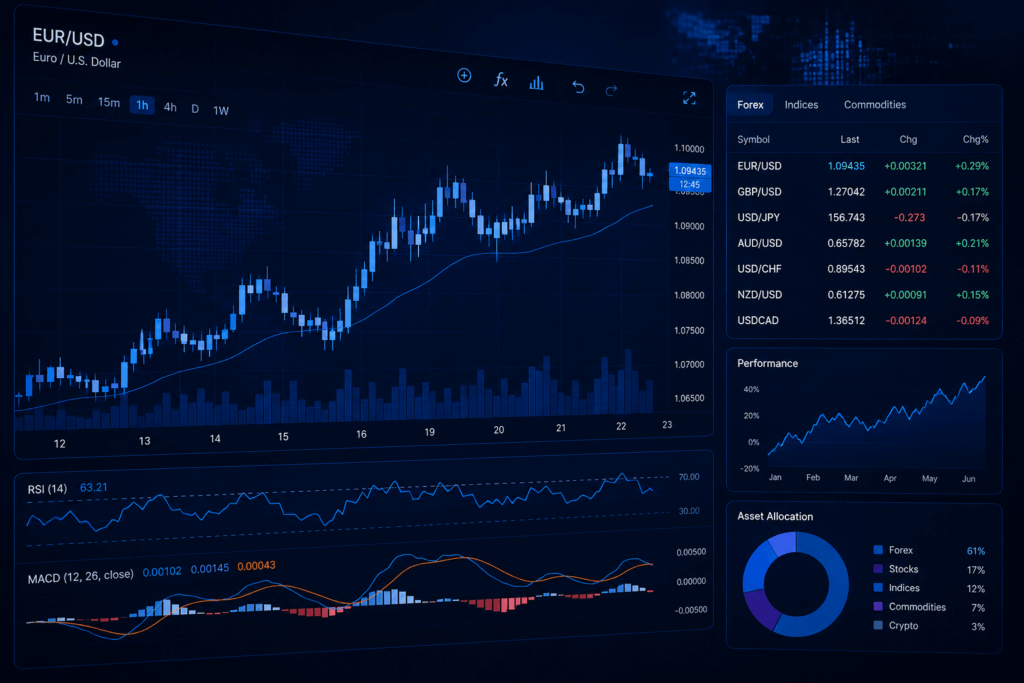
Technical Analysis in CFD Trading
Many CFD traders use technical analysis.
This involves studying price charts to identify possible trends and trading opportunities.
Common tools include:
- Moving averages
- RSI
- MACD
- Bollinger Bands
- Support and resistance
- Trend lines
Technical analysis does not predict the future but helps traders evaluate market behavior.
Fundamental Analysis
Some traders combine technical analysis with fundamental analysis.
Fundamental analysis focuses on factors that influence market prices, including:
- Economic reports
- Interest rates
- Inflation
- Company earnings
- Political events
- Central bank announcements
Understanding both technical and fundamental information may improve market awareness.
Risk Management
Successful trading is not simply about finding opportunities.
Managing risk is equally important.
Good risk management may include:
- Position sizing
- Stop-loss orders
- Risk-to-reward planning
- Diversification
- Emotional discipline
Many experienced traders focus on preserving capital before seeking profits.
Common Mistakes New CFD Traders Make
Beginners often make avoidable mistakes.
Common examples include:
- Trading without a plan
- Overusing leverage
- Ignoring stop-losses
- Trading emotionally
- Chasing losses
- Risking too much on one trade
Education and practice can help reduce these mistakes.
Is CFD Trading Suitable for Beginners?
CFDs can appear straightforward, but they involve complex concepts.
New traders should first understand:
- Market mechanics
- Risk management
- Position sizing
- Leverage
- Margin
- Trading psychology
Many brokers also offer demo accounts that allow traders to practice before using real funds.
Technology and CFD Trading
Technology has transformed modern CFD trading.
Today’s platforms often include:
- Advanced charting
- AI-assisted market insights
- Price alerts
- Mobile trading
- Market scanners
- Performance tracking
These tools help traders organize information more efficiently.
The Role of AI in Trading
Artificial intelligence is becoming increasingly common in trading platforms.
AI can assist with:
- Market analysis
- Pattern recognition
- Data organization
- Trade monitoring
AI should support decision-making rather than replace it.
Final Thoughts
Understanding CFDs meaning trading is the first step toward learning how Contracts for Difference work.
CFDs allow traders to speculate on price movements without owning the underlying asset. They provide access to multiple markets, the ability to trade rising and falling prices, and advanced trading tools.
At the same time, CFDs involve significant risks, especially when leverage is used.
Before trading CFDs, individuals should invest time in education, understand risk management principles, and become familiar with how these financial products operate.
Disclaimer
CFDs are complex financial instruments and involve a high level of risk due to leverage. Losses can exceed deposits depending on the trading conditions and applicable regulations. This article is provided for educational and informational purposes only and should not be considered financial, investment, legal, or tax advice. Individuals should conduct their own research and consult qualified financial professionals before making trading decisions.
CFDs Meaning Trading: A Complete Guide to Understanding Contracts for
One term that frequently appears in online trading is CFDs. If you’ve searched for CFDs meaning trading, you’re likely looking…
FGP1 August 2026 Performance Overview
Geographic Restriction & Risk Notice FGP1 is geographically restricted and is not available to U.S. persons or residents. Trading involves substantial…

Best Robo Advisors: A Complete Guide to Automated Investing
Choosing how to invest has become easier than ever thanks to technology. One of the biggest innovations in recent years…
Best Day Trading App: What Traders Should Look for Before
Day trading has become more accessible than ever. With the rise of mobile technology, cloud-based platforms, and real-time market data,…
FGP1 July 2026 Performance Overview
Geographic Restriction & Risk Notice FGP1 is geographically restricted and is not available to U.S. persons or residents. Trading involves substantial…
London Session Forex Time: Everything Traders Need to Know About
The foreign exchange market operates 24 hours a day, five days a week. While trading is possible around the clock,…