Table of Contents
- How Does the Russia-Ukraine War Affect Forex?
- Why Geopolitical Risk Matters in Forex
- Safe-Haven Currencies During Geopolitical Stress
- The U.S. Dollar and the Russia-Ukraine War
- Why the Euro Can Be Sensitive to the War
- The War, Energy Prices, and EUR/USD
- Energy Markets Remain Important in 2026
- Why Oil Prices Can Affect Forex
- Natural Gas and the European Economy
- Inflation Is Another Major Forex Channel
- Take control of your trading future
- How Inflation Influences Currency Markets
- The European Central Bank and War-Related Inflation
- Why Central-Bank Reactions Matter More Than Headlines
- How Sanctions Affect Forex Markets
- Sanctions and the Russian Ruble
- The Ukrainian Hryvnia and Wartime Currency Management
- Why Foreign Exchange Intervention Matters
- Trade Disruption and Currency Values
- What Is the Current Account?
- Food Prices and the War
- Emerging-Market Currencies and Global Risk
- Why Traders Watch Gold During Geopolitical Risk
- How the War Can Affect GBP/USD
- How the War Can Affect USD/CHF
- How the War Can Affect USD/JPY
- The War and Commodity Currencies
- Why Forex Reactions Can Change Over Time
- Current Forex Context in October 2026
- Why Traders Should Avoid Trading Headlines Alone
- Risk Management During Geopolitical Volatility
- Watch Currency Correlations
- Avoid Excessive Leverage
- Economic Calendars Still Matter During War
- Fundamental and Technical Analysis
- Does the Russia-Ukraine War Make Forex More Volatile?
- Can the War Create Forex Trading Opportunities?
- What Happens to Forex if the War Ends?
- The Bigger Lesson for Forex Traders
- Final Thoughts: How Does the Russia-Ukraine War Affect Forex?
The foreign exchange market reacts to much more than interest rates and economic reports.
Geopolitical events can also create major changes in currency prices.
One of the most important examples in recent years has been the ongoing Russia-Ukraine war.
Since Russia’s full-scale invasion of Ukraine in 2022, the conflict has affected energy markets, international trade, inflation, government spending, investor confidence, and central-bank policy.
All of these factors can influence forex.
So, how does the Russia-Ukraine war affect forex?
There is no single answer.
The war does not automatically make one currency rise and another fall. Instead, it affects the economic forces that traders use to value currencies.
Energy prices may increase.
Investors may search for safer assets.
European growth expectations may weaken.
Central banks may respond to higher inflation.
Sanctions may redirect international trade.
Each of these developments can influence currency markets differently.
This guide explains how the Russia-Ukraine war affects forex, which currencies may be more sensitive to geopolitical developments, and why traders should avoid oversimplifying the relationship between war and exchange rates.
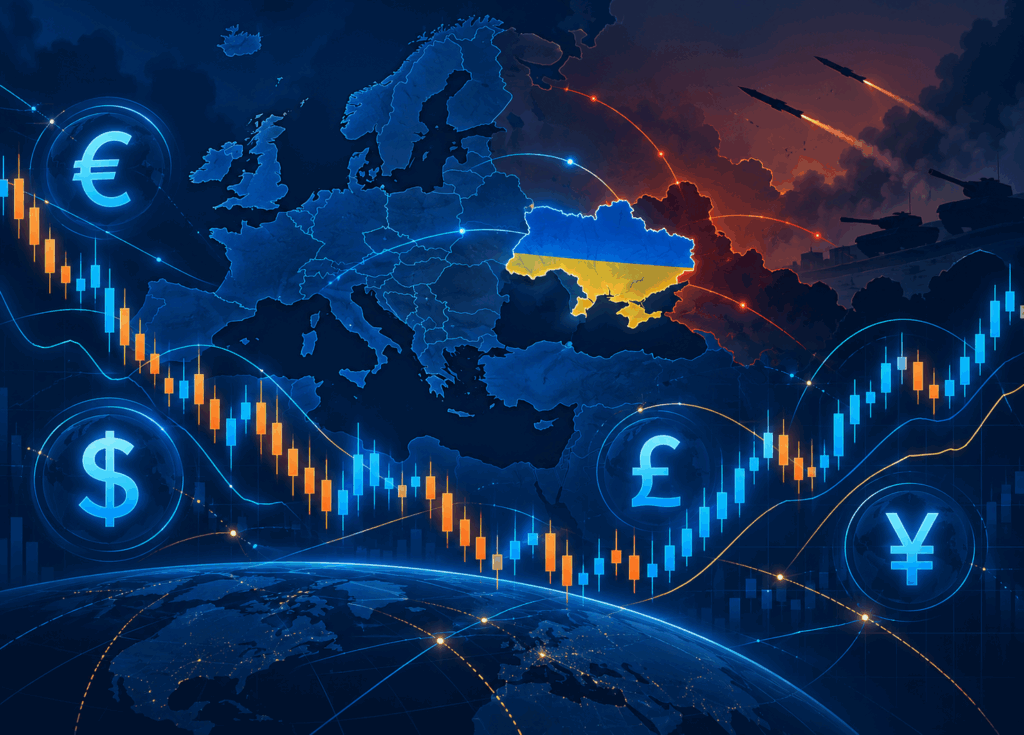
How Does the Russia-Ukraine War Affect Forex?
The Russia-Ukraine war can affect forex through several major channels.
These include:
- Energy prices
- Inflation
- Central-bank policy
- Safe-haven demand
- International trade
- Sanctions
- Commodity prices
- Economic growth
- Investor confidence
- Government spending
These forces are connected.
For example, a disruption to energy supply can cause oil or natural gas prices to rise.
Higher energy prices can increase inflation.
That may influence central-bank interest-rate decisions.
Changes in interest rates can then affect the value of a currency.
Therefore, forex traders should think about the entire chain rather than focusing only on the geopolitical event itself.
Why Geopolitical Risk Matters in Forex
Currencies represent economies.
When investors become more uncertain about an economy, region, or financial system, they may adjust where they hold capital.
This can create large flows between currencies.
Geopolitical risk can influence decisions involving:
- Investments
- Government bonds
- Cash holdings
- International trade
- Corporate financing
- Commodity purchases
If investors believe a region faces higher financial or economic risk, they may reduce exposure to assets from that region.
At the same time, demand may increase for currencies or assets that investors traditionally view as more defensive.
This is commonly called a risk-off environment.
Safe-Haven Currencies During Geopolitical Stress
Some currencies have historically attracted demand during periods of uncertainty.
Common examples include:
- U.S. dollar
- Swiss franc
- Japanese yen
However, traders should be careful with the term safe haven.
No currency is guaranteed to rise during every geopolitical crisis.
Market behavior depends on several factors at the same time.
Interest rates, monetary policy, government debt, domestic politics, and economic growth can all influence how a currency behaves.
For example, the U.S. dollar may strengthen during a risk-off period.
However, Federal Reserve policy can also influence the dollar independently of geopolitical developments.
The same principle applies to the Swiss franc and Japanese yen.
The U.S. Dollar and the Russia-Ukraine War
The U.S. dollar plays a central role in the global financial system.
It is widely used in:
- International trade
- Commodity pricing
- Global debt markets
- Central-bank reserves
- Cross-border financial transactions
During periods of uncertainty, demand for dollar-denominated assets can increase.
This may support the U.S. dollar.
However, the dollar does not respond only to geopolitical risk.
Traders must also consider:
- Federal Reserve interest rates
- U.S. inflation
- Employment
- Economic growth
- Treasury yields
- Fiscal policy
Therefore, a stronger dollar during a geopolitical crisis may reflect several forces operating simultaneously.
Why the Euro Can Be Sensitive to the War
The euro is particularly important when discussing how the Russia-Ukraine war affects forex.
The euro area is geographically close to the conflict.
European economies are also sensitive to energy prices and regional trade conditions.
Before the war, several European countries depended heavily on Russian energy.
That relationship changed significantly after the invasion.
Europe reduced its dependence on Russian pipeline gas and increased imports from other suppliers.
However, energy remains an important economic issue for the euro area.
Higher gas or oil prices can increase business costs and household expenses.
They can also influence inflation and economic growth.
As a result, major changes in the conflict can affect EUR currency pairs.
The War, Energy Prices, and EUR/USD
Energy is one of the most important links between the war and forex.
Europe imports large amounts of energy.
Therefore, sharp increases in oil or natural gas prices can create difficult economic conditions.
Higher energy costs can:
- Increase inflation
- Reduce household purchasing power
- Increase business expenses
- Weaken industrial competitiveness
- Reduce economic growth
These effects can influence expectations for the European Central Bank.
They may also influence demand for the euro.
However, EUR/USD contains two currencies.
A decline in EUR/USD does not necessarily mean the euro weakened because of Ukraine.
The U.S. dollar may simply have strengthened for another reason.
This is why forex traders should always analyze both sides of a currency pair.
Energy Markets Remain Important in 2026
The connection between the war and energy markets has not disappeared.
During 2026, attacks on energy infrastructure continued.
Russia has targeted Ukrainian energy facilities.
Ukraine has also targeted Russian oil and energy infrastructure.
These developments can affect expectations surrounding energy production, refining capacity, and supply.
At the same time, other geopolitical conflicts are also influencing global energy prices.
Therefore, traders should not automatically attribute every oil or gas movement to the Russia-Ukraine war.
The global energy market responds to several regions and producers.
Why Oil Prices Can Affect Forex
Oil is priced internationally in U.S. dollars.
Changes in oil prices can affect countries differently.
For energy-importing economies, higher oil prices may increase costs.
For major energy exporters, higher prices can sometimes improve export revenues.
This creates different currency effects.
Forex traders often monitor currencies associated with major commodity producers.
Examples may include:
- Canadian dollar
- Norwegian krone
- Australian dollar
However, the relationship between commodities and currencies is never perfect.
Domestic interest rates and economic conditions also matter.
Natural Gas and the European Economy
Natural gas has been especially important for Europe.
Gas is used for:
- Electricity generation
- Heating
- Industrial production
- Chemical manufacturing
A significant increase in European gas prices can therefore affect many parts of the economy.
If businesses face higher energy costs, profit margins may decline.
Some industries may reduce production.
Consumers may spend more on utilities and less on other products.
These changes can affect economic growth expectations.
That may eventually influence the euro.
Inflation Is Another Major Forex Channel
War can create inflation through several mechanisms.
These include:
- Higher energy prices
- Higher food prices
- Transportation costs
- Supply-chain disruption
- Higher government spending
- Commodity shortages
The Russia-Ukraine war has affected several globally important commodity markets.
Russia is a major producer and exporter of energy and raw materials.
Ukraine has historically been an important agricultural exporter.
When supply becomes less predictable, markets may price in higher risk.
This can contribute to inflation.
Take control of your trading future
Supercharge your trading with our expert advisors. Start your journey today!
How Inflation Influences Currency Markets
Inflation can affect a currency because it influences central-bank policy.
Central banks may increase interest rates when inflation remains too high.
Higher interest rates can sometimes support a currency because investors may receive higher yields on assets denominated in that currency.
However, the relationship is not automatic.
If inflation becomes extremely high while economic growth weakens, investors may become concerned about the broader economy.
Therefore, high inflation can sometimes create conflicting currency effects.
This is particularly relevant when inflation is caused by an external energy shock.
The European Central Bank and War-Related Inflation
The European Central Bank monitors geopolitical developments because they can affect inflation and growth.
When energy prices rise, the ECB must determine whether the increase is temporary or likely to spread into other prices.
For example, higher energy costs can eventually affect:
- Transportation
- Manufacturing
- Food
- Services
- Wages
If inflation remains elevated, monetary policy may stay restrictive for longer.
That can affect bond yields and currency markets.
This is one reason forex traders closely follow ECB statements during periods of geopolitical stress.
Why Central-Bank Reactions Matter More Than Headlines
A geopolitical headline can create an immediate market reaction.
However, longer-term currency trends often depend on monetary policy.
Imagine that an escalation in the war causes energy prices to rise.
The euro initially weakens because traders become concerned about European growth.
Later, the ECB signals that higher inflation may require tighter monetary policy.
That could create a different reaction.
Therefore, the same geopolitical event can create different currency movements at different stages.
Traders should avoid assuming that the first market reaction will continue indefinitely.
How Sanctions Affect Forex Markets
Sanctions are another important part of the Russia-Ukraine war.
Governments have introduced restrictions involving:
- Banks
- Energy companies
- Individuals
- Technology
- Financial transactions
- Trade
Sanctions can change how money moves internationally.
They can also influence commodity flows.
For example, restrictions on Russian energy can redirect oil or gas toward different buyers.
That may change:
- Shipping routes
- Payment methods
- Trade balances
- Commodity prices
These changes can eventually influence currencies.
Sanctions and the Russian Ruble
The Russian ruble has experienced unusual market conditions since the invasion.
Government controls, sanctions, reduced access to international financial markets, energy export revenues, and domestic monetary policy have all influenced the currency.
As a result, the ruble does not always behave like a freely traded major currency.
Traders should be careful when comparing RUB price action with normal market currencies such as EUR/USD or GBP/USD.
Capital controls and market restrictions can change how exchange rates behave.
The Ukrainian Hryvnia and Wartime Currency Management
Ukraine faces an even more direct relationship between war and foreign exchange.
The country’s economy has been affected by:
- Infrastructure damage
- Reduced exports
- Defense spending
- Energy imports
- Population displacement
- External financing needs
The National Bank of Ukraine has used foreign exchange intervention and other measures to maintain financial stability.
The exchange-rate system has also gradually become more flexible.
However, wartime conditions continue to create significant pressure.
This provides a clear example of how central banks may intervene when normal foreign exchange conditions are disrupted by war.
Why Foreign Exchange Intervention Matters
A central bank can buy or sell currencies in the market.
This is known as foreign exchange intervention.
For example, a central bank may sell foreign currency reserves and purchase its domestic currency.
This can help reduce excessive depreciation.
However, intervention uses reserves.
Therefore, central banks must manage these resources carefully.
Foreign financial support can also become important when a country faces major external financing needs.
Ukraine has received substantial international financial assistance during the war.
That support has helped maintain macroeconomic stability under extremely difficult conditions.

Trade Disruption and Currency Values
Foreign exchange markets are closely connected to international trade.
A country that exports goods receives foreign currency.
A country that imports goods needs foreign currency to pay for those purchases.
War can disrupt these flows.
For example:
- Ports may become inaccessible.
- Infrastructure may be damaged.
- Shipping insurance may become more expensive.
- Trade routes may change.
- Export production may decline.
These effects can change demand for currencies.
They can also influence a country’s current account.
What Is the Current Account?
The current account measures several international financial flows.
It includes trade in goods and services as well as certain income and transfers.
A country with a large current-account deficit generally pays more abroad than it receives through these categories.
That does not automatically make its currency weak.
However, the balance can influence long-term currency conditions.
In Ukraine’s case, wartime defense and energy imports combined with reduced export capacity have created significant external pressures.
Food Prices and the War
Ukraine and Russia are important agricultural producers.
Disruption to agricultural exports can influence global food markets.
Important products include:
- Wheat
- Corn
- Sunflower products
- Fertilizer-related inputs
Higher food prices can increase inflation around the world.
Countries that depend heavily on imported food may experience greater pressure.
This can influence central-bank policy and local currencies.
Therefore, the forex effect of the war can extend far beyond Europe.
Emerging-Market Currencies and Global Risk
Emerging-market currencies can be especially sensitive to global risk sentiment.
During periods of uncertainty, investors may reduce exposure to markets perceived as riskier.
This can create capital outflows.
Currencies may then weaken.
The effect can become stronger if the country also has:
- High external debt
- Large energy imports
- Weak foreign reserves
- High inflation
However, some commodity-exporting emerging markets may benefit from higher commodity prices.
Again, there is no universal reaction.
Why Traders Watch Gold During Geopolitical Risk
Gold is not a currency, but it often plays an important role in forex market analysis.
During periods of geopolitical uncertainty, investors may increase demand for gold.
Because gold is commonly priced in U.S. dollars, its movement can also interact with USD conditions.
Forex traders sometimes watch gold alongside currency pairs such as:
- EUR/USD
- USD/CHF
- USD/JPY
However, gold should not be treated as a guaranteed safe-haven indicator.
Its price also responds to:
- Real interest rates
- Inflation
- Central-bank demand
- Dollar strength
How the War Can Affect GBP/USD
The British pound can also respond to European geopolitical risk.
The United Kingdom is not part of the euro area, but its economy remains closely connected with Europe.
Higher energy prices can affect UK inflation and consumers.
However, GBP/USD is also influenced by:
- Bank of England policy
- UK economic growth
- U.S. interest rates
- Fiscal policy
Therefore, a war-related energy shock may affect sterling without completely determining GBP/USD.
How the War Can Affect USD/CHF
The Swiss franc has historically attracted demand during certain periods of uncertainty.
Switzerland has a reputation for political stability and a strong financial system.
As a result, investors sometimes increase exposure to CHF during risk-off periods.
However, USD/CHF also depends on the U.S. dollar.
Therefore, both currencies may receive safe-haven demand at the same time.
Swiss National Bank policy also matters.
This can make the pair more complex than simply expecting CHF to strengthen during every crisis.
How the War Can Affect USD/JPY
The Japanese yen has also historically been associated with safe-haven demand.
However, the yen’s behavior has changed at times because of Japan’s interest-rate environment.
Large interest-rate differences between Japan and other economies can influence capital flows.
Therefore, geopolitical uncertainty may support the yen while monetary policy creates pressure in the opposite direction.
This is another example of why traders should avoid simple rules.
The War and Commodity Currencies
Currencies linked to commodity-producing economies may react to changes in global resource prices.
Examples include:
- CAD
- AUD
- NOK
If geopolitical risk pushes oil or other commodity prices higher, some exporting economies may benefit.
However, traders should not assume that commodity currencies will automatically strengthen.
A severe global risk-off environment can sometimes create demand for the U.S. dollar that outweighs the commodity effect.
Therefore, currency relationships can change depending on the market environment.
Why Forex Reactions Can Change Over Time
Markets adapt.
An event that causes a large currency move during the first months of a conflict may create a smaller reaction years later.
Why?
Because traders adjust expectations.
Businesses change suppliers.
Governments change energy policies.
Markets develop new trade routes.
Investors become familiar with recurring risks.
Therefore, the forex impact of the Russia-Ukraine war in 2026 is not identical to the impact seen in 2022.
The conflict remains important.
However, markets now process it alongside many other factors.
Current Forex Context in October 2026
As of October 2026, the war continues to affect energy infrastructure and broader European economic risk.
Attacks involving energy facilities remain important because they can affect expectations for supply and prices.
At the same time, energy markets are also responding to developments outside Ukraine.
This means forex traders must separate different geopolitical factors.
A rise in oil prices may reflect:
- Russia-Ukraine developments
- Middle East conflict
- Supply restrictions
- Production decisions
- Global demand
Attributing the entire move to one event can lead to poor analysis.
Why Traders Should Avoid Trading Headlines Alone
Geopolitical news can create sharp short-term volatility.
This may encourage traders to enter positions immediately.
However, headline trading carries significant risk.
Information can change quickly.
Initial reports may be incomplete.
Markets may reverse once traders receive additional information.
Spreads may also widen during periods of extreme volatility.
Therefore, traders should avoid assuming that every breaking-news event creates an obvious trading opportunity.
Risk Management During Geopolitical Volatility
When geopolitical risk increases, normal market conditions can change quickly.
Traders may consider several risk-management principles.
These include:
- Reducing position size
- Monitoring leverage
- Using predefined stop levels
- Avoiding excessive exposure to one currency
- Watching scheduled economic announcements
- Monitoring spreads
- Preparing for increased volatility
The goal is not to predict every geopolitical event.
That is impossible.
The goal is to control what happens to the trading account when an unexpected event occurs.
Watch Currency Correlations
A trader may unknowingly take several positions based on the same idea.
For example:
- Short EUR/USD
- Long USD/CHF
- Short GBP/USD
These positions may all benefit from broad U.S. dollar strength.
If the dollar suddenly reverses, several trades may lose simultaneously.
Therefore, portfolio-level risk matters.
Traders should understand how positions are connected.
Avoid Excessive Leverage
Leverage can increase exposure to small market movements.
During normal conditions, a trader may believe a position is manageable.
However, geopolitical headlines can create fast price changes.
This can increase:
- Slippage
- Volatility
- Drawdowns
Therefore, leverage should always be used carefully.
A trader should never assume that a stop-loss order completely removes risk.
Execution can differ from the requested price during extreme market conditions.
Economic Calendars Still Matter During War
War headlines may dominate financial news.
However, scheduled economic data remains important.
Forex traders should continue monitoring:
- Central-bank meetings
- Inflation
- Employment
- GDP
- Retail sales
- Business surveys
For example, EUR/USD may react to a geopolitical event one day and an ECB announcement the next.
Successful analysis requires understanding both.
Fundamental and Technical Analysis
Geopolitical events are primarily fundamental factors.
However, technical analysis can still help traders organize market behavior.
Useful tools may include:
- Support and resistance
- Trend lines
- Moving averages
- Average True Range
- Candlestick patterns
Technical analysis can help identify where price is reacting.
Fundamental analysis can help explain why volatility is increasing.
Neither method guarantees future results.
Does the Russia-Ukraine War Make Forex More Volatile?
It can.
However, the effect depends on the specific event and currency pair.
A major escalation may create a strong short-term reaction.
A familiar recurring development may have little effect.
Volatility also depends on what traders expected before the news.
Markets often move most when reality differs significantly from expectations.
Therefore, surprising developments tend to matter more than well-anticipated ones.
Can the War Create Forex Trading Opportunities?
Volatility creates movement.
Movement can create trading opportunities.
However, greater opportunity usually comes with greater risk.
A highly volatile market can move rapidly in either direction.
Therefore, traders should not view war as a simple source of profit opportunities.
The same volatility that creates potential gains can create significant losses.
A disciplined approach remains essential.
What Happens to Forex if the War Ends?
A lasting peace agreement could affect currencies and financial markets.
For example, traders might reassess:
- European growth
- Energy supply
- Inflation expectations
- Government spending
- Risk sentiment
- Trade relationships
However, the currency reaction would depend on the details.
Markets would evaluate questions such as:
- Are sanctions removed?
- Does energy trade normalize?
- How quickly does reconstruction begin?
- What happens to European defense spending?
- How does the ECB respond?
Therefore, even peace would not create one guaranteed forex outcome.
The Bigger Lesson for Forex Traders
The Russia-Ukraine war demonstrates an important principle.
Currencies are connected to the entire global economy.
A military conflict can affect:
energy markets,
which affect inflation,
which affects central banks,
which affects interest rates,
which affects capital flows,
which affects currencies.
Understanding these relationships can help traders interpret market movements more effectively.
However, no trader can predict every part of the chain perfectly.
Risk management remains essential.
Final Thoughts: How Does the Russia-Ukraine War Affect Forex?
So, how does the Russia-Ukraine war affect forex?
The answer is through a combination of energy prices, inflation, monetary policy, international trade, sanctions, economic growth, and investor sentiment.
The euro can be sensitive because Europe is geographically close to the conflict and remains exposed to changes in energy costs.
The U.S. dollar, Swiss franc, and Japanese yen may sometimes benefit from defensive capital flows.
Commodity currencies may react to changes in oil, gas, or other raw-material prices.
The Ukrainian hryvnia and Russian ruble face more direct effects because the conflict influences their domestic economies, financial systems, and currency policies.
However, no relationship is guaranteed.
Currencies respond to many forces simultaneously.
For traders, the most useful approach is not to ask which currency must rise or fall because of the war.
Instead, ask how the latest development changes inflation, growth, interest rates, trade, and investor behavior.
That provides a more complete framework for understanding forex markets during geopolitical uncertainty.
Risk Disclaimer
Foreign exchange, CFD, commodity, cryptocurrency, stock, futures, and derivative trading involve substantial risk and may not be suitable for every trader or investor. You may lose some or all of the capital committed to trading.
This article is provided solely for general educational and informational purposes. It does not constitute financial, investment, trading, legal, tax, political, or geopolitical advice.
References to the Russia-Ukraine war, currencies, energy markets, sanctions, central-bank policies, and historical market behavior are included only to explain general financial-market concepts. Nothing in this article should be interpreted as a recommendation to buy, sell, or hold any currency, commodity, security, or other financial instrument.
Geopolitical events can develop rapidly. Information available at the time of publication may later change. Currency markets may respond differently from historical patterns or expectations.
Historical market behavior does not guarantee future results. Safe-haven relationships, commodity correlations, and reactions to geopolitical events can change over time.
Before trading, carefully consider your objectives, financial circumstances, knowledge, experience, and risk tolerance. Where appropriate, seek independent advice from a qualified financial professional.
How Does the Russia-Ukraine War Affect Forex? Currency Markets, Energy
The foreign exchange market reacts to much more than interest rates and economic reports. Geopolitical events can also create major changes…

AI to Buy and Sell Crypto: How AI-Powered Crypto Trading
Artificial intelligence is becoming a major part of modern financial technology. As a result, more traders are exploring how to…
Define Foreign Exchange Management: A Complete Guide to Managing Currency
To define foreign exchange management in simple terms, it is the process of identifying, monitoring, and managing the financial risks…
FGP1 September 2026 Performance Overview
Geographic Restriction & Risk Notice FGP1 is geographically restricted and is not available to U.S. persons or residents. Trading involves substantial…
Australian Dollar (AUD): Why It Strengthened in 2026 and What
The Australian dollar (AUD) has attracted considerable attention in the foreign exchange market throughout 2026. After experiencing a notable appreciation…
Quantitative Trading: A Complete Guide to Data-Driven Trading Strategies
Quantitative trading has changed the way many traders approach financial markets. Instead of making every decision based on instinct, chart…