Table of Contents
- What Is Foreign Exchange Management?
- Why Is Foreign Exchange Management Important?
- The Foreign Exchange Market Explained
- What Causes Currency Exchange Rates to Move?
- The Main Types of Foreign Exchange Exposure
- Transaction Exposure
- Translation Exposure
- Economic Exposure
- Investment Exposure
- Foreign Exchange Management for Businesses
- What Is Foreign Exchange Hedging?
- Forward Contracts
- Currency Futures
- Currency Options
- Currency Swaps
- Natural Hedging
- Foreign Exchange Management for Traders
- Position Sizing
- Managing Leverage
- Stop-Loss Orders
- Currency Correlation
- Daily Loss Limits
- Foreign Exchange Management and Central Banks
- Interest Rates and Foreign Exchange
- Inflation and Currency Risk
- Political and Geopolitical Risk
- Liquidity and Foreign Exchange Management
- The Importance of a Foreign Exchange Management Policy
- Step-by-Step Foreign Exchange Management Process
- Common Foreign Exchange Management Mistakes
- Hedging vs Speculation
- Can Foreign Exchange Risk Be Completely Eliminated?
- Foreign Exchange Management and Technology
- Why Forecasting Alone Is Not Foreign Exchange Management
- Define Foreign Exchange Management in One Sentence
- Final Thoughts
- Risk Disclaimer
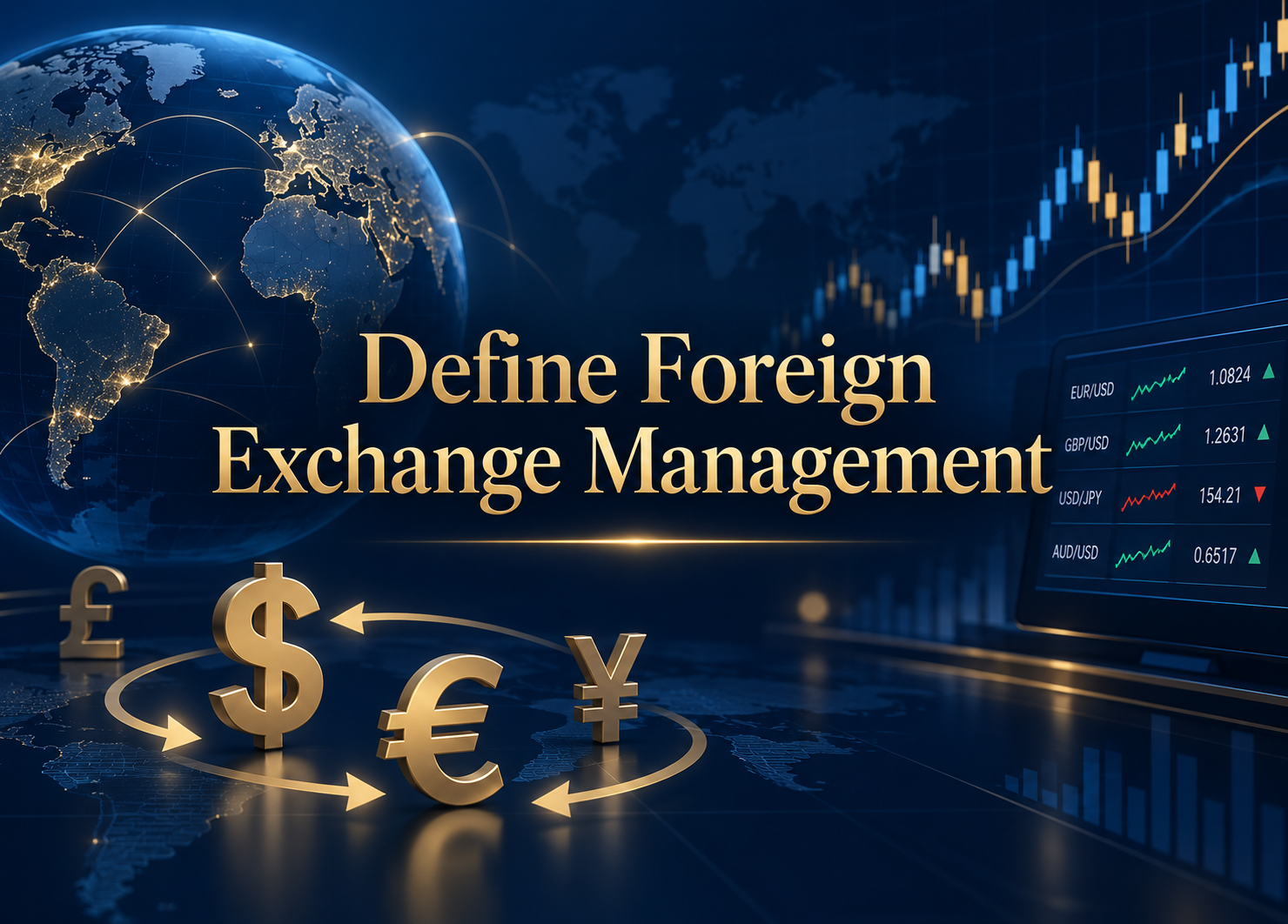
To define foreign exchange management in simple terms, it is the process of identifying, monitoring, and managing the financial risks that come from changes in currency exchange rates.
Foreign exchange rates constantly move.
As a result, businesses, investors, and traders who deal with more than one currency may see the value of their money, investments, revenues, costs, or trading positions change.
Foreign exchange management aims to understand those risks and decide how they should be handled.
For a global business, that may mean protecting future payments from unfavorable currency movements. For an investor, it can involve managing foreign-currency exposure inside a portfolio. For a trader, it may mean controlling position size, leverage, and overall exposure when participating in the forex market.
Therefore, foreign exchange management is much broader than simply buying and selling currencies.
It combines planning, risk management, market analysis, and financial decision-making.
In this guide, we will define foreign exchange management, explain why it matters, examine different types of currency exposure, explore common risk-management tools, and discuss how businesses and traders can build a more structured approach to the foreign exchange market.

What Is Foreign Exchange Management?
Foreign exchange management is the process of controlling financial exposure to changes in currency values.
The foreign exchange market determines how much one currency is worth compared with another.
For example, the EUR/USD exchange rate shows the value of the euro relative to the U.S. dollar.
When that rate changes, the financial impact can extend far beyond forex traders.
It can affect:
- International businesses
- Importers
- Exporters
- Investors
- Banks
- Governments
- Travelers
- Multinational companies
- Forex traders
Any person or organization that receives, pays, holds, invests, or trades money in multiple currencies can potentially face foreign exchange risk.
Foreign exchange management creates a framework for dealing with that risk.
Currency prices can change quickly.
Why Is Foreign Exchange Management Important?
Even relatively small movements can have a meaningful financial effect when large amounts of money are involved.
Imagine a European company that must pay a U.S. supplier $1 million in three months.
Today, the company knows approximately how many euros are required to obtain those dollars.
However, the EUR/USD exchange rate may change before the payment is due.
If the euro weakens against the dollar, the company may need more euros to make the same $1 million payment.
The business therefore has foreign exchange exposure.
Foreign exchange management helps the company understand that exposure before the payment date arrives.
The same principle applies to investors and traders.
Currency movements can influence profits, losses, portfolio values, and trading risk.
The Foreign Exchange Market Explained
Before we define foreign exchange management in greater detail, it helps to understand the market itself.
The foreign exchange market is where currencies are exchanged.
Currencies are normally quoted in pairs.
Common examples include:
- EUR/USD
- GBP/USD
- USD/JPY
- AUD/USD
- USD/CAD
- USD/CHF
In the EUR/USD pair, the euro is the base currency and the U.S. dollar is the quote currency.
If EUR/USD rises, the euro has strengthened relative to the dollar.
If EUR/USD falls, the euro has weakened relative to the dollar.
These movements create both financial risks and trading opportunities.
What Causes Currency Exchange Rates to Move?
Foreign exchange rates are influenced by many factors.
These include:
- Interest rates
- Inflation
- Central bank policy
- Economic growth
- Employment data
- Political developments
- Government policy
- Trade flows
- Capital flows
- Market sentiment
- Supply and demand
Because these variables constantly change, exchange rates can be difficult to predict.
That uncertainty is why foreign exchange management exists.
The goal is not necessarily to predict every currency movement.
Instead, the goal is to understand the exposure and prepare for different outcomes.
The Main Types of Foreign Exchange Exposure
Foreign exchange risk does not always appear in the same way.
Businesses and investors can face several forms of exposure.
Transaction Exposure
Transaction exposure occurs when a future payment or receipt is denominated in a foreign currency.
For example, suppose a British company sells goods to a U.S. customer.
The customer agrees to pay $500,000 in 60 days.
The British company will eventually convert those dollars into pounds.
However, the GBP/USD exchange rate may change before the money arrives.
Therefore, the value of the payment in pounds is uncertain.
This is transaction exposure.
Translation Exposure
Translation exposure can affect multinational businesses.
A company may own subsidiaries in several countries.
When the company prepares financial statements, foreign assets, liabilities, revenue, and expenses may need to be converted into the reporting currency.
Changes in exchange rates can change the reported value of those foreign operations.
This does not always involve an immediate cash loss.
However, it can influence financial reporting.
Economic Exposure
Economic exposure is broader.
It describes how currency movements may affect the long-term competitiveness and future cash flows of a business.
For example, imagine a company manufactures products in Europe but competes against U.S. manufacturers.
A significant change in EUR/USD could make European products more or less expensive for international customers.
Therefore, exchange rates may influence future sales and profitability.
Investment Exposure
Economic exposure can be difficult to measure because it can affect the entire business model.
Investors can also face currency risk.
Suppose an investor uses euros to purchase U.S. stocks.
Even if the stocks increase in dollar terms, the final return in euros may be affected by changes in EUR/USD.
Therefore, international investing contains two potential sources of movement:
- The investment itself
- The exchange rate
Foreign exchange management can help investors understand both.
Foreign Exchange Management for Businesses
Businesses often use foreign exchange management to create more predictable financial outcomes.
The process may begin by identifying all future foreign-currency payments and receipts.
Management can then ask:
- Which currencies are involved?
- How much money is exposed?
- When will payments occur?
- How much currency movement can the business tolerate?
- Should the exposure be hedged?
This allows the company to make decisions before exchange rates move significantly.
What Is Foreign Exchange Hedging?
Hedging is one of the most important concepts in foreign exchange management.
A hedge is a position or financial arrangement designed to reduce the impact of an unfavorable market movement.
Hedging does not necessarily eliminate all risk.
It may instead reduce uncertainty.
Several tools can be used.
Forward Contracts
A foreign exchange forward contract allows two parties to agree on an exchange rate today for a transaction that will occur later.
For example, a company knows that it must buy U.S. dollars three months from now.
A forward contract can lock in an exchange rate for that future date.
This creates more certainty.
However, the company may not benefit if the market later moves in its favor.
The exchange rate has already been agreed upon.
Currency Futures
Currency futures are standardized contracts traded on organized exchanges.
Like forwards, they can be used to manage future currency exposure.
However, futures differ because contract terms are standardized.
They may also require margin.
Businesses and traders should understand the structure before using them.
Currency Options
A currency option gives the holder the right, but generally not the obligation, to exchange currencies at a defined rate.
Options can provide more flexibility than a simple forward contract.
For example, a company may protect itself from an unfavorable currency movement while retaining some ability to benefit from a favorable movement.
However, options normally involve a premium.
That cost must be considered.
Currency Swaps
Currency swaps involve exchanging cash flows in different currencies.
They can be used by large businesses and financial institutions to manage longer-term currency requirements.
Currency swaps can become complex.
Therefore, they are generally associated with more sophisticated financial operations.
Natural Hedging
Not every foreign exchange management strategy requires a derivative.
A business may use natural hedging.
For example, a company that receives U.S. dollar revenue may also pay certain expenses in U.S. dollars.
Instead of converting all dollar revenue into euros and later purchasing dollars again, the business may use part of its dollar revenue to pay dollar expenses.
This reduces the amount that must be exchanged.
Natural hedging can simplify some currency exposure.
Foreign Exchange Management for Traders
Foreign exchange management has a different meaning for active forex traders.
A trader is generally trying to benefit from currency movements rather than eliminate them.
Therefore, the focus shifts toward risk control.
For a trader, foreign exchange management can involve:
- Position sizing
- Stop-loss placement
- Leverage limits
- Correlation management
- Daily loss limits
- Portfolio exposure
- Trading session selection
The objective is to participate in currency movements without allowing one position to create unacceptable losses.
Position Sizing
Position size is one of the most important parts of forex risk management.
A trader should determine how much capital will be exposed before opening the position.
The same strategy can create very different results depending on position size.
A small position may create manageable volatility.
An oversized position can create severe losses from the same market movement.
Therefore, risk should determine position size.
Managing Leverage
Forex trading can involve leverage.
Leverage allows a trader to control a position that is larger than the capital committed to it.
This can increase potential gains.
It also increases potential losses.
Foreign exchange management should therefore include clear leverage limits.
The maximum leverage offered by a platform should not automatically become the amount a trader uses.

Stop-Loss Orders
A stop-loss order is designed to close a position when the market reaches a predefined level.
This can help traders control individual trade risk.
However, stop losses do not guarantee the exact execution price.
During sudden market moves, gaps, or low liquidity, execution can differ.
Therefore, traders should understand both stop placement and position sizing.
Currency Correlation
Traders sometimes open several positions that appear different but actually create similar exposure.
For example, multiple positions may depend on the U.S. dollar moving in the same direction.
If the dollar suddenly reverses, several trades may lose at the same time.
Therefore, foreign exchange management should consider overall portfolio exposure rather than evaluating each trade independently.
Daily Loss Limits
Active traders may set a maximum daily loss.
Once that limit is reached, trading stops for the session.
This can help prevent emotional decisions after several losing trades.
A daily loss limit can also reduce the risk of revenge trading.
Therefore, businesses and traders often monitor central bank announcements when managing foreign exchange exposure.Therefore, businesses and traders often monitor central bank announcements when managing foreign exchange exposure.
Foreign Exchange Management and Central Banks
Central banks play a major role in foreign exchange markets.
Examples include:
- Federal Reserve
- European Central Bank
- Bank of England
- Bank of Japan
- Swiss National Bank
Central banks influence interest rates and monetary policy.
These decisions can significantly affect currency values.
Therefore, businesses and traders often monitor central bank announcements when managing foreign exchange exposure.
Interest Rates and Foreign Exchange
Interest rates are closely connected with currency markets.
Higher interest rates can sometimes make a currency more attractive because investors may earn higher returns on assets denominated in that currency.
However, the relationship is not always simple.
Markets often react to expectations.
If investors already expect a rate increase, the currency may have already adjusted before the announcement.
Therefore, foreign exchange management should consider both current policy and market expectations.
Inflation and Currency Risk
Inflation affects purchasing power.
It can also influence central bank policy.
If inflation rises significantly, a central bank may increase interest rates.
That can influence the currency.
Businesses with long-term foreign exchange exposure may therefore monitor inflation trends.
Traders may also watch inflation reports because they can create significant volatility.
Political and Geopolitical Risk
Currencies can react strongly to political events.
Examples include:
- Elections
- Government policy changes
- Trade disputes
- International conflicts
- Unexpected political instability
These events can create rapid changes in market sentiment.
Foreign exchange management cannot predict every political event.
However, a good risk framework can prepare for unexpected volatility.
Liquidity and Foreign Exchange Management
Liquidity describes how easily an asset can be traded without causing a significant price change.
Major currency pairs generally have high liquidity.
However, liquidity can change throughout the day.
It can also decrease during:
- Holidays
- Major news releases
- Market transitions
- Unexpected events
Lower liquidity can increase spreads and slippage.
Therefore, businesses and traders should consider when transactions are executed.
The Importance of a Foreign Exchange Management Policy
Larger organizations often create formal policies.
A foreign exchange management policy may define:
- Which exposures must be monitored
- Which currencies are included
- Who can approve transactions
- Which hedging tools may be used
- How much exposure may remain unhedged
- How results are reported
The purpose is consistency.
Without a policy, different employees may manage similar risks in completely different ways.
Step-by-Step Foreign Exchange Management Process
A structured process can make currency risk easier to manage.
Step 1: Identify the Exposure
Determine which currencies are involved.
List future payments, receipts, investments, and obligations.
Step 2: Measure the Risk
Estimate how much the financial outcome could change if exchange rates move.
Step 3: Establish Risk Limits
Decide how much currency risk is acceptable.
Step 4: Choose the Response
Possible responses include:
- Accepting the exposure
- Reducing the exposure
- Hedging
- Changing transaction timing
- Using natural hedging
Step 5: Monitor the Market
Exchange rates and economic conditions change.
Therefore, exposure should be reviewed regularly.
Step 6: Measure Results
Compare actual results with the original objectives.
This can help improve future foreign exchange decisions.
Common Foreign Exchange Management Mistakes
Foreign exchange risk can be managed poorly even when sophisticated tools are available.
Common mistakes include:
- Ignoring currency exposure
- Using excessive leverage
- Speculating instead of hedging
- Failing to understand derivative products
- Taking oversized positions
- Relying entirely on exchange-rate forecasts
- Ignoring transaction costs
- Failing to monitor changing exposure
The solution is usually a clearer process.
Hedging vs Speculation
Hedging and speculation should not be confused.
A hedge is generally designed to reduce an existing risk.
Speculation intentionally takes market risk in an attempt to earn a profit.
For example, a company that must pay dollars in three months may hedge the payment.
If the company instead takes an additional dollar position because management believes the currency will rise, that additional position is speculation.
The difference is the purpose of the trade.
Can Foreign Exchange Risk Be Completely Eliminated?
Not always.
Some exposures can be significantly reduced.
Others are difficult to hedge precisely.
There may also be costs associated with hedging.
Therefore, foreign exchange management often involves choosing which risks should be reduced and which can be accepted.
The goal is not necessarily zero risk.
The goal is controlled risk.
Foreign Exchange Management and Technology
Technology has changed currency risk management.
Modern systems can help businesses and traders:
- Monitor exchange rates
- Track exposure
- Generate alerts
- Calculate risk
- Automate reporting
- Execute trades
- Analyze historical data
Artificial intelligence may also help identify market patterns and process information.
However, technology does not eliminate uncertainty.
Good risk management still requires clear rules and human oversight.
Why Forecasting Alone Is Not Foreign Exchange Management
Forecasting can be useful.
However, foreign exchange management should not depend entirely on predicting the next market move.
Nobody can predict exchange rates consistently with certainty.
A stronger approach asks:
“What happens if our forecast is wrong?”
That question leads directly to risk management.
Businesses can prepare for multiple currency scenarios.
Traders can define exits before entering positions.
This makes the process more robust.
Define Foreign Exchange Management in One Sentence
If we define foreign exchange management as simply as possible, it is the structured process of understanding and controlling financial exposure created by changes in currency exchange rates.
That definition applies across many situations.
A business may manage currency payments.
An investor may manage foreign investments.
A trader may manage leveraged forex positions.
The tools differ, but the principle remains the same.
Understand the exposure before deciding how much risk to accept.
Final Thoughts
Foreign exchange management plays an important role wherever money crosses currency boundaries.
Exchange rates can influence business costs, international revenue, investments, and trading results.
Therefore, currency risk should not be
ignored.
Businesses can use tools such as forwards, options, futures, swaps, and natural hedging.
Traders can focus on position size, leverage, stop losses, correlation, and overall account exposure.
In both cases, the objective is similar.
Identify the risk.
Measure it.
Decide how much risk is acceptable.
Then manage the exposure according to a clear plan.
When people ask to define foreign exchange management, the simplest answer is that it provides a structured way to deal with the uncertainty created by changing currency values.
It does not eliminate uncertainty from financial markets.
Instead, it helps businesses, investors, and traders approach that uncertainty with greater structure and control.
Risk Disclaimer
Foreign exchange trading, CFDs, derivatives, cryptocurrencies, and other financial instruments involve substantial risk and may not be suitable for every individual. Currency prices can change rapidly, and leveraged trading can result in significant losses.
The information in this article is provided for general educational and informational purposes only. It does not constitute financial, investment, trading, legal, accounting, or tax advice.
Examples involving hedging, forwards, options, futures, swaps, currency trading, and risk-management techniques are provided only to explain general concepts. They should not be interpreted as recommendations to enter any specific financial transaction or use any particular strategy.
No foreign exchange management technique can eliminate all financial risk. Market conditions, liquidity, execution, regulation, costs, and individual circumstances can materially affect outcomes.
Before making financial, investment, hedging, or trading decisions, consider your objectives, circumstances, experience, and risk tolerance. Where appropriate, seek independent advice from a qualified financial professional.
Define Foreign Exchange Management: A Complete Guide to Managing Currency
To define foreign exchange management in simple terms, it is the process of identifying, monitoring, and managing the financial risks…
FGP1 September 2026 Performance Overview
Geographic Restriction & Risk Notice FGP1 is geographically restricted and is not available to U.S. persons or residents. Trading involves substantial…

Australian Dollar (AUD): Why It Strengthened in 2026 and What
The Australian dollar (AUD) has attracted considerable attention in the foreign exchange market throughout 2026. After experiencing a notable appreciation…
Quantitative Trading: A Complete Guide to Data-Driven Trading Strategies
Quantitative trading has changed the way many traders approach financial markets. Instead of making every decision based on instinct, chart…
CFDs Meaning Trading: A Complete Guide to Understanding Contracts for
One term that frequently appears in online trading is CFDs. If you’ve searched for CFDs meaning trading, you’re likely looking…
FGP1 August 2026 Performance Overview
Geographic Restriction & Risk Notice FGP1 is geographically restricted and is not available to U.S. persons or residents. Trading involves substantial…