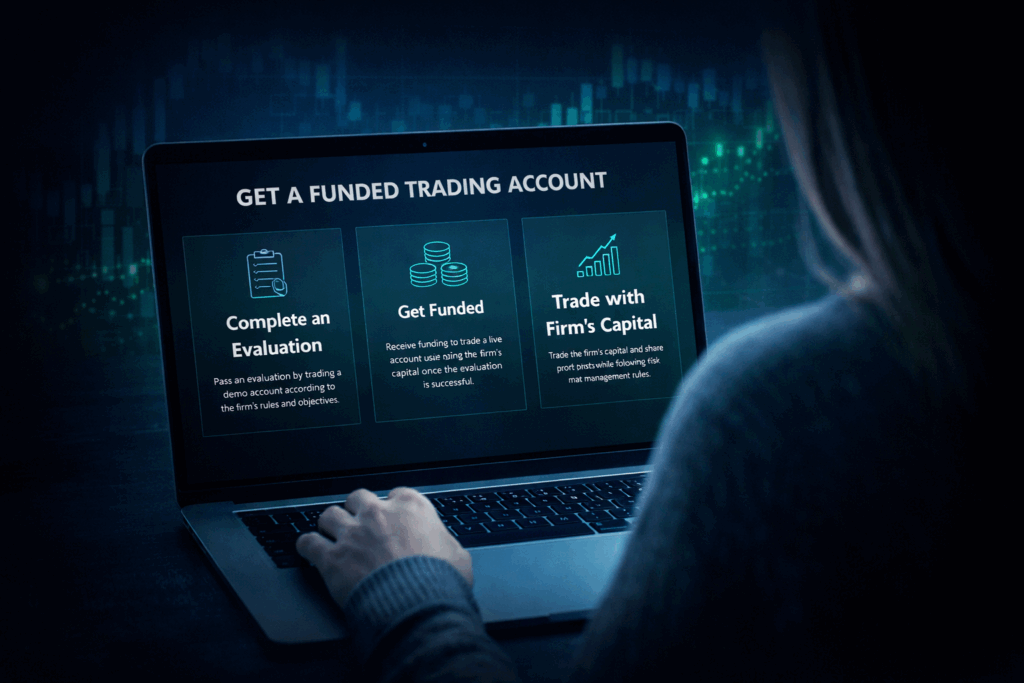
A funded trading account is one of the most searched topics in trading today. Many people hear about it and think it is an easy way to trade with more money. That is why the idea gets so much attention.
On the surface, it sounds simple. You prove that you can trade well, a firm gives you access to capital, and then you keep part of the profits. That sounds exciting, especially for traders who do not want to risk a large amount of personal money.
Still, the reality is more detailed than that.
A funded trading account is not free money. It is not a shortcut to becoming profitable. It is also not a guaranteed income stream. In most cases, traders must pass an evaluation first. They need to follow rules, manage risk, and show discipline before they get access to a funded account.
That is why it is important to understand how this model really works.
In this guide, you will learn what a funded trading account is, how the process works, what the main pros and cons are, and who this type of account is truly meant for.
What Is a Funded Trading Account?
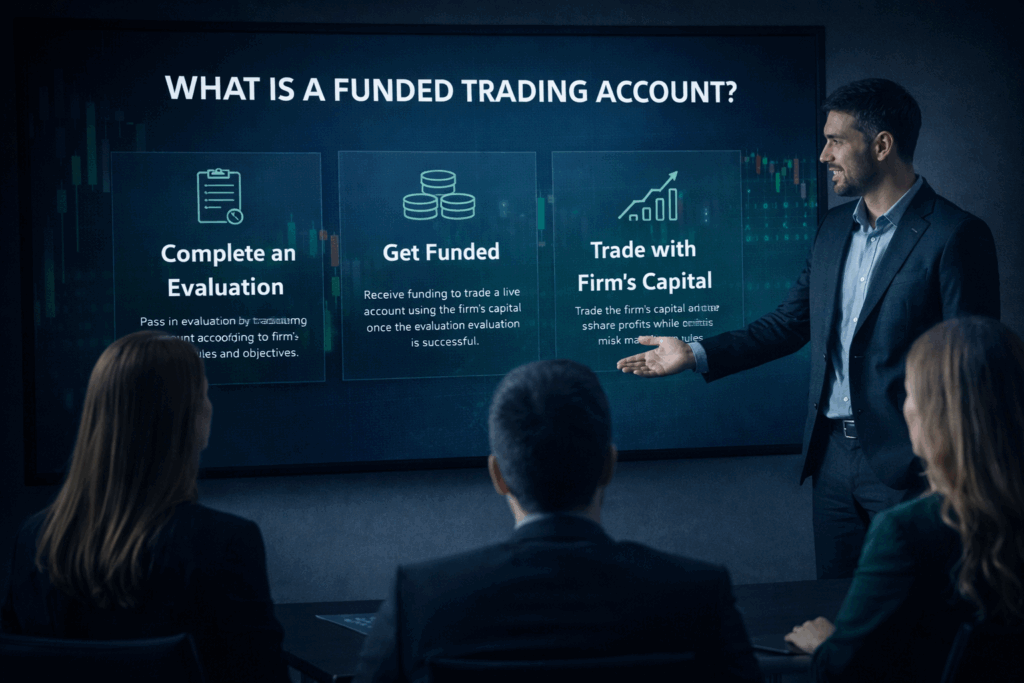
A funded trading account is a trading account provided by a prop firm or funded trading company. Instead of trading only with your own money, you get access to firm-backed capital after meeting certain conditions.
In simple terms, the company wants to see whether you can trade responsibly. If you can, it may allow you to trade a larger account and earn a percentage of the profits.
This model has become popular because many traders have one major problem. They may have interest and motivation, but they do not have enough capital to trade at a meaningful level.
A funded trading account tries to solve that problem.
Instead of asking you to build a large personal account first, the firm asks you to prove your trading ability. If you pass, you may receive access to a larger balance.
Most funded trading accounts come with rules such as:
- maximum daily loss
- maximum total drawdown
- profit target requirements
- minimum trading day requirements
- consistency rules
- restrictions around news events
- weekend holding rules
- position size limits
These rules are there for a reason. A funded trading company wants disciplined traders, not reckless gamblers.
How Does a Funded Trading Account Work?
Most funded trading programs follow a similar structure. The details may change from one provider to another, but the process is usually close to the same.
The evaluation phase
First, the trader enters an evaluation phase. Some companies call it a challenge. Others call it an assessment.
During this phase, the trader must reach a profit target while staying within strict risk limits. The goal is not just to make money. The goal is to make money while showing control.
For example, a trader may need to:
- hit a certain profit target
- avoid exceeding a daily loss limit
- stay within a total drawdown rule
- complete a minimum number of trading days
This stage is meant to test patience, consistency, and risk management.
The verification phase
Some firms use a second phase after the first one. This is often called verification.
The rules may stay the same, but the profit target may be lower. The purpose is to confirm that the trader did not simply get lucky during the first phase.
The funded stage
After passing the required steps, the trader gets access to the funded trading account.
At this point, the trader can begin trading under the company’s rules. If profits are made and the rules are respected, the trader becomes eligible for payouts.
Profit split and payouts
With a funded trading account, the profits are usually shared between the trader and the firm.
This is called a profit split.
The trader keeps a percentage of the gains, while the company keeps the rest. Payout schedules vary, but many firms offer regular withdrawal periods once the trader qualifies.
Why Funded Trading Accounts Are So Popular
The popularity of the funded trading account model did not happen by accident. It appeals to traders for several clear reasons.
First, it offers access to more capital.
Second, it creates structure.
Third, it gives traders a way to earn based on performance instead of depending only on the size of their personal account.
For many traders, this sounds like a much faster path than trying to grow a very small account over a long time.
Some of the main reasons people like funded trading accounts include:
- access to larger account sizes
- lower need for personal starting capital
- clear rules and structure
- performance-based opportunity
- the ability to scale without risking a large personal balance
That said, popularity does not mean simplicity. A funded trading account may look attractive, but success still depends on discipline.
What Can You Trade in a Funded Trading Account?
This depends on the company, but many funded trading programs offer access to markets such as:
- forex
- indices
- commodities
- crypto
- stocks
- futures
Not every firm offers all markets. Some focus mostly on forex. Others specialize in futures or other instruments.
That is why traders should always check what products are available before signing up. A strategy that works in one market may not work well in another.
The Main Benefits of a Funded Trading Account
A funded trading account can offer real advantages for the right trader.
Access to more capital
This is the biggest reason people are interested. A trader with limited personal funds may still gain access to a larger account.
Less pressure on personal savings
Instead of depositing a large amount of personal money, the trader works through a structured model.
Built-in risk framework
The rules force traders to think about loss limits, position sizing, and discipline. For many people, that structure is helpful.
Performance-based opportunity
The trader is rewarded for results. If they trade well and follow the rules, they may earn payouts without building a large account from scratch.
A clear learning experience
Even the challenge process can teach important lessons. Traders often discover weaknesses in their decision-making, patience, or emotional control.
The Downsides of a Funded Trading Account
Funded trading accounts also come with real drawbacks. It is important to understand those before getting involved.
Strict rules
The rules can be difficult, especially for inexperienced traders. A strategy may be profitable over time but still fail under a tight short-term drawdown rule.
Emotional pressure
A trader may feel strong pressure to hit the target quickly. That pressure often leads to mistakes.
Evaluation fees
Many firms charge a fee to enter the challenge. If a trader keeps failing and retrying, the cost can add up.
Not all firms are equal
Some firms are more transparent and reliable than others. Terms, support, payout systems, and platform quality can vary a lot.
False expectations
A funded trading account does not fix bad habits. It often exposes them faster.
Who Is a Funded Trading Account Really For?
This is where many people need to be honest with themselves.
A funded trading account is usually best for traders who already have some foundation. It fits people who understand the basics, have a defined strategy, and can manage risk without letting emotions take over.
It may be a strong fit for:
- traders with skill but limited capital
- traders who already follow a plan
- disciplined people who can respect rules
- patient traders focused on consistency
- people who want structure in their trading
It may not be a good fit for:
- complete beginners with no strategy
- people looking for instant income
- traders who revenge trade
- people who treat trading like gambling
- anyone who constantly changes strategy under pressure
In other words, a funded trading account is usually for the trader who wants process, not excitement.
Common Mistakes Traders Make
Many traders fail funded evaluations for the same reasons. These mistakes happen again and again.
Trading too aggressively
Some traders try to reach the target as fast as possible. That often leads to oversized trades and unnecessary losses.
Ignoring the rules
A profitable trade does not help if it breaks the account terms. Many traders focus only on profit and forget the rule structure.
Switching strategies too quickly
A few losses happen, the trader panics, and suddenly changes the entire plan. This usually makes performance worse.
Revenge trading
After a bad trade, some people jump back in just to recover fast. That emotional reaction often destroys progress.
Treating the challenge like a race
A funded trading account rewards patience. Many traders fail because they think speed matters more than consistency.
How to Prepare for a Funded Trading Account
Preparation matters a lot. Many traders try a challenge too early and end up wasting money.
Before starting, you should know the following.
Your strategy
You should know:
- what market you trade
- what setups you take
- where you enter
- where you exit
- how much you risk per trade
- when you stay out of the market
If you cannot explain your strategy clearly, you are not ready yet.
The drawdown rules
You must understand how the daily loss and total drawdown are calculated. Some traders lose accounts because they misunderstand the rules.
Risk management
A trader who risks too much rarely lasts. Smaller, controlled risk often gives a better chance of passing and keeping the account.
Realistic expectations
A funded trading account is not about getting rich fast. It is about showing that you can trade responsibly over time.
The provider terms
Always review the terms before paying. Look at:
- payout conditions
- trading restrictions
- inactivity rules
- account breach rules
- scaling conditions
Why Discipline Matters More Than Strategy
Many traders spend too much time searching for the perfect entry and not enough time building discipline.
In funded trading, discipline often matters more than strategy.
A simple strategy can work well when the trader manages risk, stays patient, and avoids emotional mistakes.
At the same time, a smart strategy can still fail when the trader gets impatient, ignores limits, or starts chasing the market.
That is why funded trading reveals the truth about a trader’s habits.
Ask yourself:
- can you follow your plan after a losing trade?
- can you stop when you hit your risk limit?
- can you sit out when there is no clear setup?
- can you protect the account instead of chasing action?
These questions matter more than most people think.
Are Funded Trading Accounts Worth It?
For the right trader, a funded trading account can absolutely be worth it.
It can provide access to more capital. It can create discipline. It can reward strong performance without requiring the trader to build a large personal account first.
But for the wrong trader, it can become an expensive cycle of failed challenges and frustration.
The difference comes down to preparation, expectations, and self-control.
A funded trading account can make sense for someone who:
- already has a working strategy
- understands risk
- respects rules
- wants to trade with structure
- is patient enough to focus on consistency
It usually does not work well for someone who wants fast money without doing the work.

Final Thoughts
A funded trading account sounds exciting because it offers a chance to trade with more capital. That is the part most people notice first.
But the real story is deeper than that.
A funded trading account is a test of patience, discipline, and risk control. It is designed to reward traders who can follow rules and protect capital. It is not built for people who want to gamble or rush the process.
For some traders, it can open the door to meaningful opportunity.
For others, it can expose habits they still need to fix.
That is why the most important question is not just what a funded trading account is. The better question is whether you are ready for one.
If you can stay disciplined, manage losses calmly, and think long term, a funded trading account may be a smart next step.
If not, the best move may be to improve your process first.
Because in the end, success with a funded trading account depends less on the balance size and more on the quality of the trader using it.
Disclaimer: This content is for educational and informational purposes only. It is not financial advice, investment advice, or trading advice. Trading involves risk, and losses can occur. Funded trading programs may include fees, rules, restrictions, and payout conditions that vary by provider. Always do your own research and review the terms carefully before participating in any trading activity.

Australian Dollar (AUD): Why It Strengthened in 2026 and What
The Australian dollar (AUD) has attracted considerable attention in the foreign exchange market throughout 2026. After experiencing a notable appreciation…
Quantitative Trading: A Complete Guide to Data-Driven Trading Strategies
Quantitative trading has changed the way many traders approach financial markets. Instead of making every decision based on instinct, chart…
CFDs Meaning Trading: A Complete Guide to Understanding Contracts for
One term that frequently appears in online trading is CFDs. If you’ve searched for CFDs meaning trading, you’re likely looking…
FGP1 August 2026 Performance Overview
Geographic Restriction & Risk Notice FGP1 is geographically restricted and is not available to U.S. persons or residents. Trading involves substantial…

Best Robo Advisors: A Complete Guide to Automated Investing
Choosing how to invest has become easier than ever thanks to technology. One of the biggest innovations in recent years…

Best Day Trading App: What Traders Should Look for Before
Day trading has become more accessible than ever. With the rise of mobile technology, cloud-based platforms, and real-time market data,…