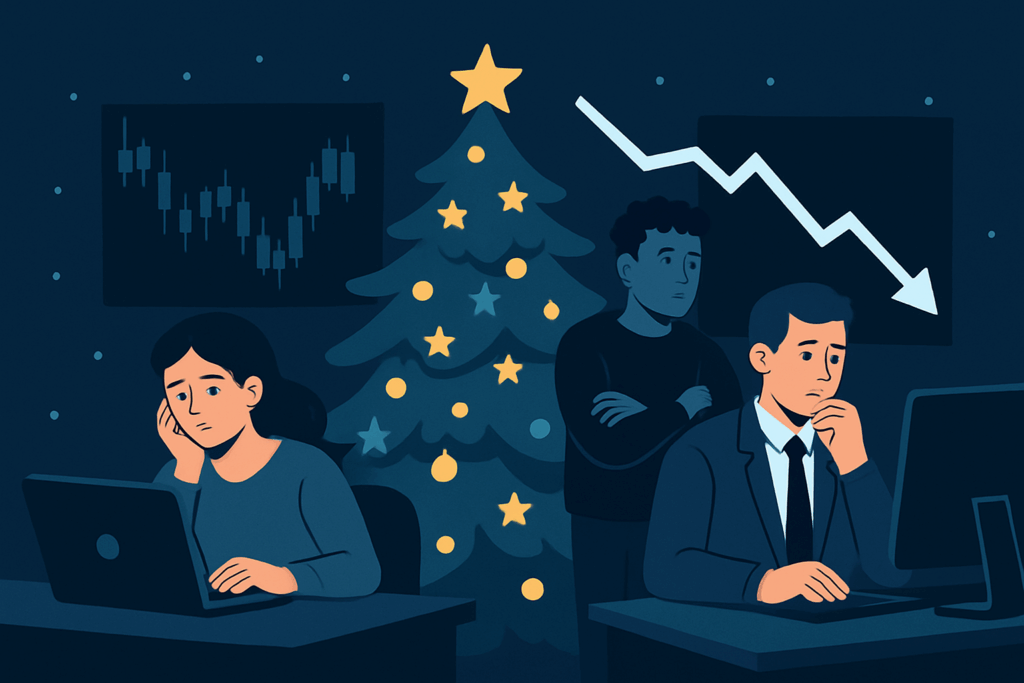
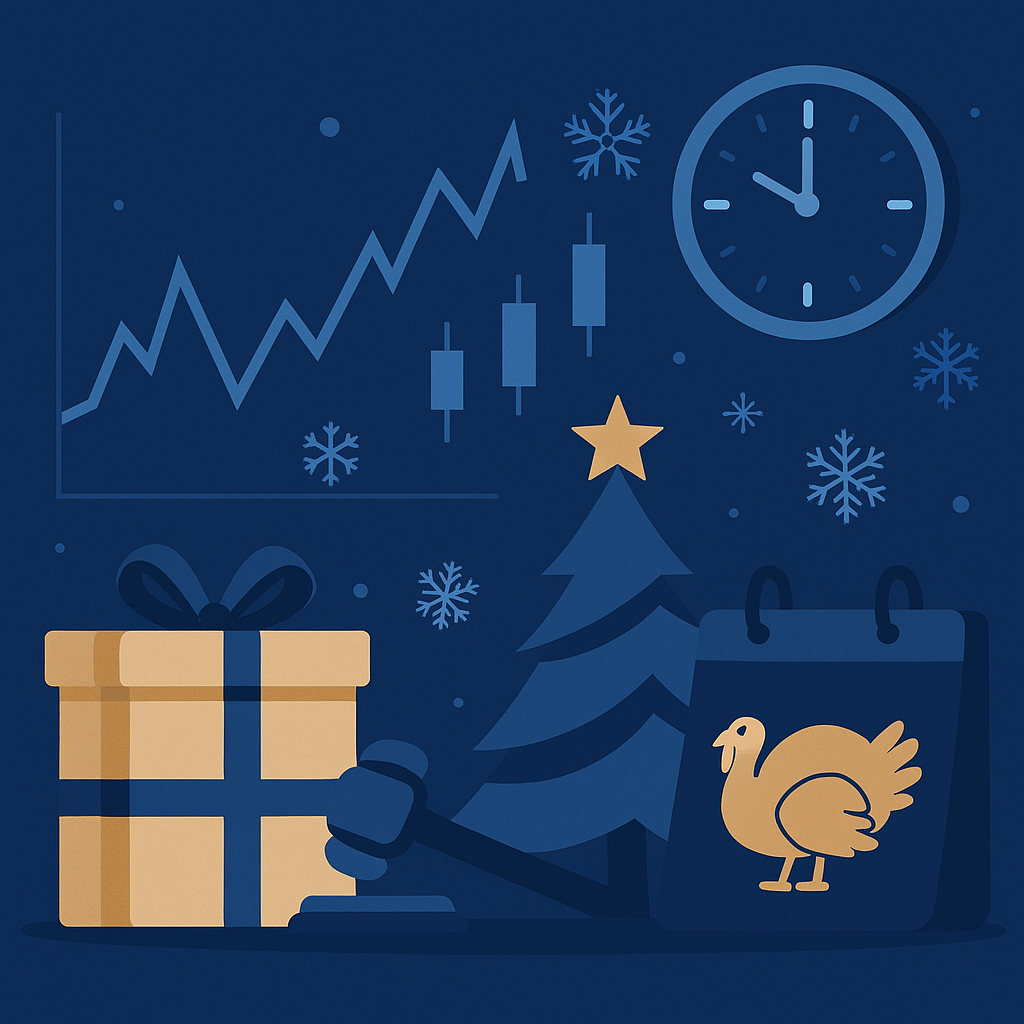
Forex traders quickly learn that the market has a “personality shift” around the holidays. Volatility dries up, spreads widen, and clean technical patterns suddenly act like they’ve had too much eggnog. Understanding forex trading holidays—especially Thanksgiving, Christmas, and New Year’s—can help you protect your capital, avoid frustration, and even spot a few unique opportunities.
In this guide, we’ll walk through:
- Why the market behaves differently during holiday periods
- How Thanksgiving week typically affects forex liquidity
- What to expect from Christmas and New Year’s (“the dead zone”)
- Other global holidays that can impact forex trading
- A practical Holiday Trading Playbook you can follow each year
By the end, you’ll have a clear, repeatable framework for navigating forex trading holidays without guesswork.
Why Holidays Matter in Forex Trading
Forex is famously a 24/5 market, but that doesn’t mean it’s always equally active. The market is driven by:
- Banks and institutional desks
- Hedge funds and asset managers
- Corporations hedging currency exposure
- Retail traders and smaller participants
When major financial centers go on holiday, the big players step away. That doesn’t “close” the forex market, but it changes its character:
- Reduced liquidity
- Fewer large orders in the book
- Thinner market depth at each price level
- Fewer large orders in the book
- Wider spreads
- Brokers and liquidity providers protect themselves from gaps and jumps by widening spreads.
- This hits intraday traders and scalpers especially hard.
- Brokers and liquidity providers protect themselves from gaps and jumps by widening spreads.
- More random price action
- With less institutional participation, smaller flows can move price more than usual.
- You might see sudden spikes, weird wicks, and reversals that don’t follow the same logic as normal sessions.
- With less institutional participation, smaller flows can move price more than usual.
- Unreliable technical signals
- Your favorite pattern might appear—but on low volume and thin liquidity, its edge is weaker.
- Backtests often don’t fully reflect these odd holiday conditions.
- Your favorite pattern might appear—but on low volume and thin liquidity, its edge is weaker.
This is why serious traders have a mental (or written) calendar of forex trading holidays and adjust their risk—or simply step aside—accordingly.
Thanksgiving Week: The First Major Slowdown
In the United States, Thanksgiving is on the fourth Thursday of November. While forex is global, the US dollar is still the world’s primary reserve currency and a huge driver of flows. When the US goes on holiday, the FX landscape changes.
Let’s break down what typically happens during Thanksgiving week (all in New York time):
Monday and Tuesday – Mostly Normal, But Watch for Positioning
- Liquidity is still fairly normal.
- You might see some pre-holiday position adjustments:
- Traders squaring up open positions
- Cutting risk ahead of thinner conditions later in the week
- Traders squaring up open positions
- News can still move the market normally, especially if there are big data releases.
How to trade it:
- You can usually trade your normal plan on Monday and Tuesday.
- Just be aware that larger moves might be faded as participants “clean up” their books before the break.
Wednesday – Liquidity Starts to Thin (Especially Afternoon)
The day before Thanksgiving is technically a normal business day in the US, but in practice:
- Many desks start winding down early.
- After London close, the US afternoon often gets noticeably quieter.
- Moves can get choppier and more erratic as fewer big players are active.
How to trade it:
- Trade normally in the London session and early US if liquidity looks reasonable.
- Consider reducing size or walking away after London close, especially if you’re scalping or using tight stops.
- If you’re swing trading on higher timeframes, you may still find decent setups—but be prepared for slower follow-through and random spikes.
Thursday – Thanksgiving Day: Effectively a US “Offline” Session
On Thanksgiving Day:
- US banks, stock markets, and many corporations are closed.
- London and Asia are open, but USD-related flows are muted.
- Many brokers widen spreads and sometimes adjust trading hours for certain products (especially metals and indices).
How to trade it:
- For most traders, this is a “no trade” day, especially on USD majors and crosses.
- If you must trade:
- Stick to much smaller size.
- Avoid scalping and entries that rely on ultra-tight spreads.
- Be prepared for sudden jumps if a larger order hits a thin book.
- Stick to much smaller size.
Friday – Black Friday: Half-Strength Market
The day after Thanksgiving, Black Friday, is a shortened day for US equities and a de facto half-holiday:
- Many professionals simply don’t return to full trading.
- Liquidity is still thinner than normal.
- Price can drift or spike on relatively small order flow.
How to trade it:
- Treat it as “holiday-lite”:
- Reduce position size.
- Avoid revenge trading or forcing trades just because you’re at your desk.
- Reduce position size.
- If you’re a longer-term trader, you might use this day for planning, journaling, and analysis, rather than live risk.
In short: Thanksgiving week is the first clear sign that the “holiday season” is beginning for forex traders—and it sets the tone for what’s coming in December.
Christmas & New Year’s: The True “Dead Zone”
While Thanksgiving causes a noticeable slowdown, Christmas and New Year’s bring the biggest liquidity drop of the year. For many traders, this is when their forex trading holidays truly kick in.
Christmas Eve (December 24)
- Several major centers (especially in Europe) have shortened trading days or are very quiet.
- Many institutional desks run with minimal staff.
- Spreads often widen even during “normal” hours, especially on less liquid pairs.
How to trade it:
- If you trade at all, do it lightly and early in the session.
- Consider closing intraday positions before the afternoon and being flat going into Christmas.
Christmas Day (December 25)
On Christmas Day:
- The majority of the Western financial world is closed or effectively offline.
- It’s one of the quietest days of the entire year for forex.
How to trade it:
- The most professional answer is: Don’t.
- Use the time to step away, reset, and let your brain recharge.
Boxing Day (December 26)
In countries like the UK, Canada, Australia, and parts of Europe, December 26 is Boxing Day, another major holiday:
- London is closed or extremely light.
- Without the London session, liquidity in EUR, GBP, and many crosses is still significantly reduced.
How to trade it:
- Treat this as a continuation of the holiday lull.
- Focus on big-picture planning, not intraday trading.
The “No-Man’s Land” – December 27 to ~December 30
The days between Christmas and New Year’s are often called the “dead zone.”
- Markets are technically open, but:
- Many institutional players are still on vacation.
- Corporate hedging flows taper off.
- Volumes are low, and algorithmic/automated trading plays a larger role.
- Many institutional players are still on vacation.
You can see two types of behavior in this window:
- Sideways drift with low volatility
- Sudden, sharp moves when a single larger order hits a thin market
Both can be tricky.
How to trade it:
- If you’re a scalper or day trader, this is often a frustrating time—your edge may be severely muted.
- For swing traders, it can still be workable, but:
- Place stops where they can survive random volatility.
- Consider smaller size and wider stops to reflect lower liquidity.
- Place stops where they can survive random volatility.
New Year’s Eve (December 31)
On New Year’s Eve:
- There are year-end fixing flows earlier in the day (portfolio rebalancing, hedging, etc.).
- After that, activity drops sharply as traders close up for the year.
- Liquidity falls off again later in the session.
How to trade it:
- Be cautious about trading around any fixings or unusual spikes.
- Many seasoned traders choose to be mostly or completely flat by the end of this day and start fresh in the new year.
New Year’s Day (January 1)
- Global holiday for most of the world.
- FX is theoretically open in some locations, but practically, it’s one big snooze.
How to trade it:
- Again, the professional move is usually: don’t trade.
- Use this time to review:
- Your previous year’s performance
- Your plan and goals for the new trading year
- Adjustments to risk, strategies, and systems
- Your previous year’s performance
Other Forex Trading Holidays to Watch (Beyond Thanksgiving & Christmas)
While this article focuses on Thanksgiving, Christmas, and New Year’s, many other holidays also affect the flow of forex trading holidays throughout the year.
Knowing these helps you avoid misreading the market on days when “nothing is moving” and you’re wondering why.
Western / US & European Holidays
These mainly impact USD, EUR, GBP, CAD, AUD, NZD and major crosses.
- Good Friday (March/April, date varies)
- Major Western markets are closed.
- Liquidity is extremely light; conditions can resemble Christmas in mini-form.
- Major Western markets are closed.
- Easter Monday
- Markets like the UK and parts of Europe are closed or quiet.
- The London session is heavily impacted, which reduces liquidity in EUR and GBP pairs.
- Markets like the UK and parts of Europe are closed or quiet.
- US Independence Day – July 4
- US session is quiet, especially after London closes.
- Depending on the day of the week, it can create a long weekend effect.
- US session is quiet, especially after London closes.
- US Memorial Day & Labor Day (last Monday in May, first Monday in September)
- Both create long weekends, leading to quieter Mondays and sometimes sluggish Fridays.
- Both create long weekends, leading to quieter Mondays and sometimes sluggish Fridays.
Asian Holidays
These mostly impact JPY, CNH, SGD, and related crosses, especially in the Asian session.
- Lunar New Year (late January or February)
- Several Asian financial centers (China, Hong Kong, Singapore, etc.) are closed or operating at low capacity.
- Asian-session liquidity is reduced, which impacts overnight trading for many pairs.
- Several Asian financial centers (China, Hong Kong, Singapore, etc.) are closed or operating at low capacity.
- Japan’s Golden Week (late April–early May)
- A cluster of Japanese holidays close together.
- JPY liquidity can become very thin, increasing the risk of air pockets and sharp spikes.
- A cluster of Japanese holidays close together.
You don’t need to memorize every global holiday, but you do want the mindset:
“If price is acting dead or strangely erratic, could today be a holiday in a major financial center?”
A quick calendar check can save you from misreading the tape.
Get Kraitos Elite Now!
Supercharge your trading with our expert advisors. Start your journey today!
Your Holiday Trading Playbook
Let’s turn all of this into something practical you can use as a checklist around forex trading holidays.
1. Mark the Key Dates Every Year
At minimum, put these recurring windows on your calendar:
- Thanksgiving week (US)
- Wednesday afternoon (NY)
- Thursday (Thanksgiving Day)
- Friday (Black Friday)
- Wednesday afternoon (NY)
- Christmas & New Year’s
- December 24 – Christmas Eve
- December 25 – Christmas Day
- December 26 – Boxing Day (UK/Europe/Canada/Aus)
- December 27–30 – “dead zone” (thin but open)
- December 31 – New Year’s Eve
- January 1 – New Year’s Day
- December 24 – Christmas Eve
Additionally, note:
- Good Friday & Easter Monday
- US Memorial Day, Independence Day, Labor Day
- Lunar New Year & Golden Week if you regularly trade Asian pairs
2. Adjust Your Expectations and Strategy
During forex trading holidays, normal rules don’t fully apply. Consider adjusting:
- Position Size
- Cut your size significantly. Think 25–50% of normal risk per trade.
- Treat holiday trading as “half-speed” mode if you trade at all.
- Cut your size significantly. Think 25–50% of normal risk per trade.
- Stop Loss & Take Profit Placement
- Avoid ultra-tight stops that rely on perfect liquidity.
- Allow a bit more room to avoid being wicked out by random spikes.
- Consider more modest profit targets if the market isn’t moving much.
- Avoid ultra-tight stops that rely on perfect liquidity.
- Timeframes
- If you usually scalp on 1–5 minute charts, consider higher timeframes (H1, H4, D1) or skipping trading entirely.
- Holiday markets often don’t provide the steady flow scalpers need.
- If you usually scalp on 1–5 minute charts, consider higher timeframes (H1, H4, D1) or skipping trading entirely.
- Strategy Type
- Trend-following intraday systems may underperform in low-volatility, choppy conditions.
- Mean-reversion strategies can sometimes work—but thin markets can spike right through “logical” levels, so risk control is critical.
- Trend-following intraday systems may underperform in low-volatility, choppy conditions.
3. Give Your EA or Trading Plan a “Holiday Filter”
If you use an Expert Advisor or structured trading plan, build in a holiday filter:
- A simple version:
- No new trades on:
- Thanksgiving Day
- Christmas Eve & Christmas Day
- Boxing Day
- New Year’s Eve & New Year’s Day
- Thanksgiving Day
- Reduced risk (e.g., half position size) from:
- Wednesday afternoon before Thanksgiving
- The days between Christmas and New Year’s
- Wednesday afternoon before Thanksgiving
- No new trades on:
- This can protect you from unnecessary drawdowns caused purely by bad conditions, not by your strategy’s logic.
4. Shift Focus: From Trading to Improvement
One of the healthiest ways to approach forex trading holidays is to embrace the slower period and use it strategically.
Instead of obsessing over finding trades in a dead market, you can:
- Review and tag your trade journal for the year
- Analyze equity curves, drawdowns, and best/worst months
- Optimize or refine your trading plan
- Backtest new ideas or filters
- Plan your goals and risk parameters for the coming year
- Organize your data, screenshots, and notes
This way, the holiday period becomes an asset, not a frustration.
5. Protect Your Mindset
It’s easy to fall into these traps around the holidays:
- “I’m off work, I have more time, I should trade more.”
- “I’m behind on my goals; I’ll make it up before the year ends.”
- “The market is slow, but I’ll just force a few trades to see what happens.”
Those thoughts are dangerous.
The reality is:
- Thin conditions often increase risk, not opportunity.
- The best professionals frequently trade less, not more during forex trading holidays.
- Capital preservation and emotional reset are long-term edges.
Allowing yourself to step back without guilt can be one of the most powerful decisions you make each year.
Conclusion: Make Forex Trading Holidays Work For You
The holiday season doesn’t mean forex shuts down—but it absolutely means the quality of the market changes.
The key takeaways:
- Thanksgiving week brings the first slowdown, especially from Wednesday afternoon through Black Friday.
- Christmas and New Year’s create the true “dead zone”, with December 24–26 and December 31–January 1 being the most illiquid days.
- Other global holidays like Good Friday, Easter Monday, Lunar New Year, and Golden Week also thin liquidity in specific sessions and currency pairs.
- During these forex trading holidays, you should:
- Reduce risk and position size
- Avoid ultra-tight stops and high-frequency scalping
- Consider a holiday filter in your trading rules or EA
- Use the time to review, plan, and improve, rather than forcing trades
- Reduce risk and position size
When you respect the calendar and align your trading with the rhythm of the market, you stop fighting seasonal conditions and start working with them.
Forex trading holidays don’t have to be a source of frustration; they can be a built-in system for rest, reflection, and strategic reset, setting you up for a stronger, more focused trading year ahead.

Best Robo Advisors: A Complete Guide to Automated Investing
Choosing how to invest has become easier than ever thanks to technology. One of the biggest innovations in recent years…

Best Day Trading App: What Traders Should Look for Before
Day trading has become more accessible than ever. With the rise of mobile technology, cloud-based platforms, and real-time market data,…
FGP1 July 2026 Performance Overview
Geographic Restriction & Risk Notice FGP1 is geographically restricted and is not available to U.S. persons or residents. Trading involves substantial…

London Session Forex Time: Everything Traders Need to Know About
The foreign exchange market operates 24 hours a day, five days a week. While trading is possible around the clock,…


FGP1 June 2026 Performance Overview
Geographic Restriction & Risk Notice FGP1 is geographically restricted and is not available to U.S. persons or residents. Trading involves substantial…

AI Stock Trading: How Artificial Intelligence Is Changing the Way
Artificial intelligence is transforming industries around the world, and financial markets are no exception. What once required hours of chart…