- Forex vs Stokcs Introduction
- 1. What Is Forex?
- 2. What Is Stock Trading?
- 3. Comparing Market Size and Liquidity
- 4. Trading Hours
- 5. Leverage and Capital Requirements
- 6. Factors Driving Each Market
- 7. Advantages of Forex Trading
- 8. Advantages of Stock Trading
- 9. Challenges of Forex Trading
- 10. Challenges of Stock Trading
- 11. Which Market Suits You?
- 12. Case Study: Forex vs Stock Trader
- 13. How Auvoria Prime Makes Forex Smarter
- 14. FAQs
- Conclusion
Forex vs Stokcs Introduction
The financial world is full of opportunities, and two of the most well-known markets are forex and stocks. At first glance, they may appear similar. Both involve buying and selling assets in order to make a profit, and both are highly popular among traders worldwide. But once you dig deeper, you’ll notice that forex and stocks are actually very different. They each have their own characteristics, risks, strategies, and ideal types of traders.
At Auvoria Prime, our mission is to give traders an edge. We combine education, automation, and advanced technology so that people can trade smarter, not harder. This means understanding not just how trading works, but also which market best suits your goals.
This article will explore the key differences between forex and stocks, highlighting their advantages, challenges, and trading opportunities. By the end, you’ll have a clear understanding of which market aligns with your goals and how Auvoria Prime’s tools can help you succeed.
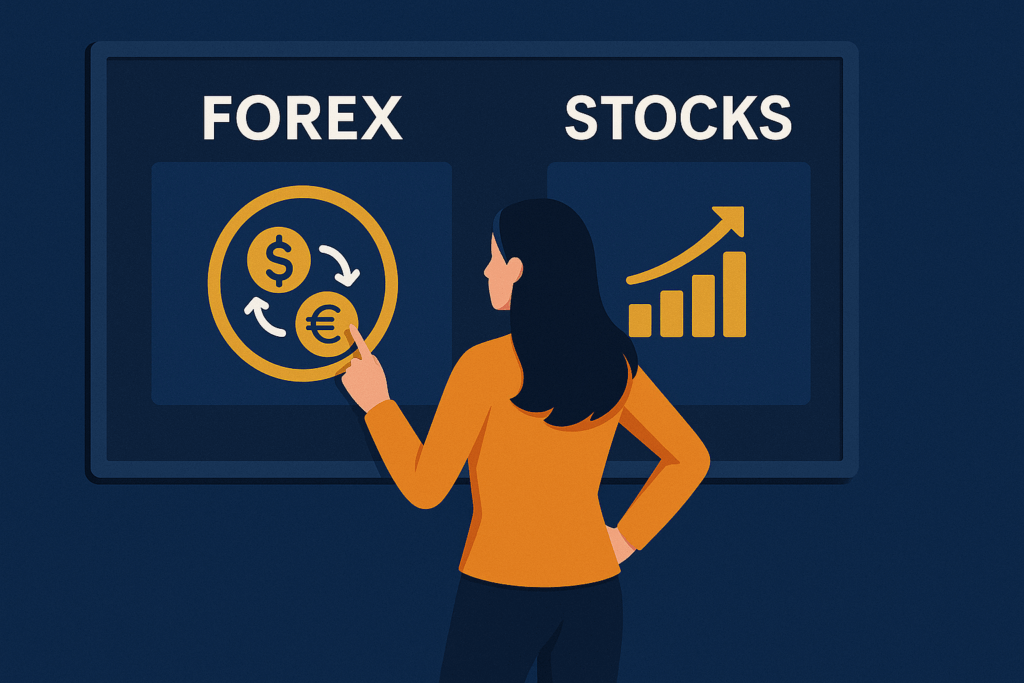
1. What Is Forex?
Forex, or the foreign exchange market, is the global marketplace for buying and selling currencies. Every time you travel abroad and exchange your local money for another currency, you’re participating in forex at the most basic level. Traders, however, take this to another level by speculating on price movements.
With an average daily volume exceeding $7.5 trillion, forex is by far the largest financial market in the world. Unlike stocks, which deal in ownership of companies, forex deals in currency pairs. For example:
- EUR/USD (Euro vs. US Dollar)
- GBP/JPY (British Pound vs. Japanese Yen)
- USD/CHF (US Dollar vs. Swiss Franc)
When trading forex, you’re always buying one currency and selling another. If you believe the euro will strengthen against the US dollar, you buy EUR/USD. If you expect the opposite, you sell.
The forex market is decentralized, meaning there’s no single physical exchange. Instead, it’s a vast electronic network of banks, brokers, and institutions connected worldwide. It is open 24 hours a day, five days a week, covering all global time zones.
2. What Is Stock Trading?
Stock trading is the buying and selling of shares in publicly traded companies. A stock represents partial ownership in a company. If you buy one share of Apple, you own a small fraction of Apple itself.
Stock trading takes place on centralized exchanges, such as the New York Stock Exchange (NYSE) or Nasdaq in the United States. These exchanges have fixed trading hours, typically from 9:30 am to 4 pm EST.
Investors choose stocks for several reasons:
- Capital growth: A company’s stock price may rise over time.
- Dividends: Some companies share profits with shareholders.
- Ownership: Buying a stock means owning part of a company and having voting rights.
Stocks are heavily influenced by company performance. Earnings reports, product launches, and management changes can all impact share prices. Broader industry trends and economic conditions also play a role.
3. Comparing Market Size and Liquidity
One of the biggest differences between forex and stocks is market size. The forex market trades more than $7.5 trillion daily, while global stock markets average about $200 billion in daily transactions. This makes forex nearly forty times larger.
With that size comes liquidity. In forex, particularly the major pairs like EUR/USD, trades can be entered and exited almost instantly. The spreads — the difference between buying and selling prices — are very small. Stocks can also be liquid, especially for large companies like Apple or Microsoft, but smaller companies often lack consistent volume.
For traders, liquidity matters because it reduces slippage and makes it easier to enter or exit positions at desired prices.
4. Trading Hours
Forex offers unmatched flexibility. Because it operates across all major financial centers — London, New York, Tokyo, Sydney — it remains open 24 hours a day, Monday through Friday. This is ideal for traders worldwide, as you can trade at times that suit your schedule.
Stocks, however, are restricted to exchange hours. In the US, the NYSE and Nasdaq are open from 9:30 am to 4 pm EST. While some brokers offer pre-market and after-hours trading, liquidity is lower and spreads are wider. This can be a limitation for those with full-time jobs or those living in different time zones.
5. Leverage and Capital Requirements
Forex trading is known for its leverage. Depending on your broker and regulations, leverage may range from 1:30 up to 1:500. This means that with just $1,000, you could control positions worth $30,000 or even more.
This makes forex attractive for smaller traders, but it also increases risk. Leverage magnifies both profits and losses. Without proper risk management, traders can lose their capital quickly.
Stocks generally allow less leverage. In the US, margin accounts typically provide 1:2 leverage for long positions and 1:4 for day trading. While this limits risk compared to forex, it also means you need more upfront capital to see significant returns.
6. Factors Driving Each Market
Forex is driven primarily by macroeconomic events:
- Interest rate decisions by central banks.
- Inflation and employment data.
- Geopolitical events such as wars or elections.
- Global trade balances and monetary policy.
Stocks, on the other hand, are more company-specific:
- Earnings reports.
- Management decisions.
- Product launches.
- Industry trends.
That said, both markets are influenced by global economic conditions. A recession or financial crisis affects currencies and stocks alike, though often in different ways.
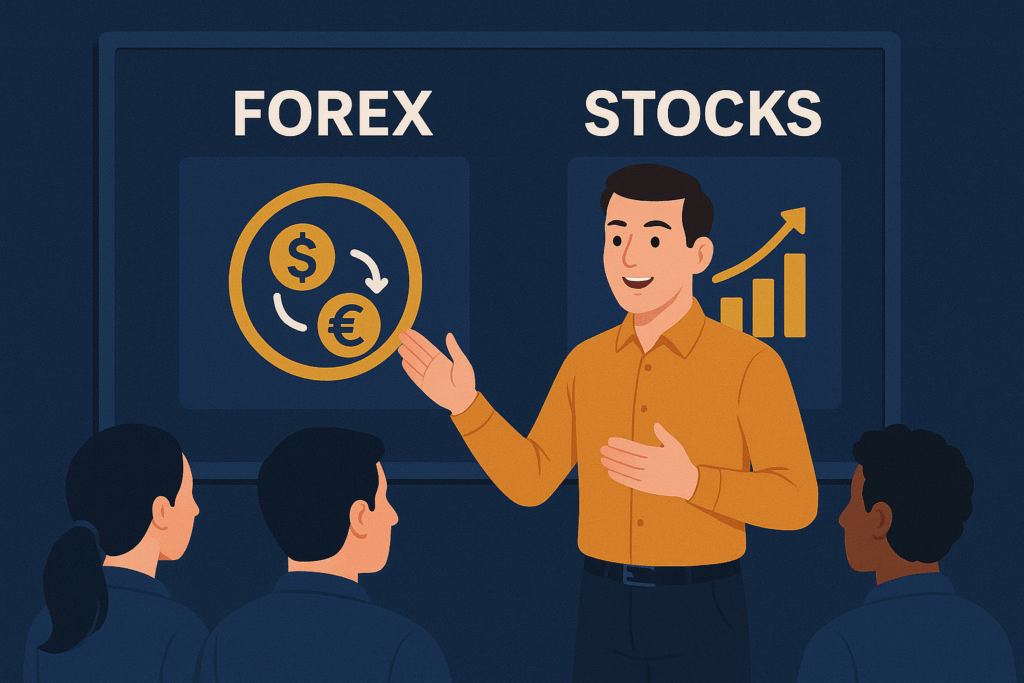
ggf7. Advantages of Forex Trading
- High liquidity ensures fast execution.
- Low transaction costs as many brokers only charge spreads.
- Accessibility with lower capital requirements.
- Flexibility to trade around your schedule.
- Leverage amplifies opportunities.
- Technology-driven with automation and bots.
At Auvoria Prime, we designed products like Kraitos, KraitosX, and Gearbox specifically to maximize these advantages while controlling the risks.
8. Advantages of Stock Trading
- Ownership of a tangible asset.
- Dividends provide passive income.
- Transparency due to regulatory requirements.
- Long-term growth potential when investing in strong companies.
- Lower volatility than forex for many large-cap stocks.
Many people prefer stocks because they are perceived as more stable. Investors often hold them for years or even decades.
Take control of your trading future
Supercharge your trading with our expert advisors. Start your journey today!
9. Challenges of Forex Trading
- High volatility: Prices can swing sharply within minutes.
- Leverage risks: Traders may overexpose themselves.
- Emotional discipline: Greed and fear can ruin strategies.
- Market complexity: Requires understanding of global economics.
10. Challenges of Stock Trading
- Limited hours: Missed opportunities outside trading sessions.
- Capital requirements: Larger funds needed for significant returns.
- Overnight risk: Stocks can gap up or down before markets open.
- Company risk: Even big firms can collapse unexpectedly.
11. Which Market Suits You?
Your choice depends on your goals and personality.
Forex might suit you if:
- You enjoy fast-paced trading.
- You prefer trading outside of regular business hours.
- You want to use automation.
- You are comfortable with higher risk.
Stocks might suit you if:
- You prefer long-term investing.
- You value stability and dividends.
- You want tangible ownership.
- You’re interested in analyzing company performance.
Some traders use both: holding stocks for long-term growth while actively trading forex for short-term profits.
12. Case Study: Forex vs Stock Trader
Consider two traders:
Trader A (Forex): Starts with $2,000 and trades EUR/USD with 1:30 leverage. Using a disciplined strategy, they target 1–2 percent per week. Over a year, this can compound into significant returns.
Trader B (Stocks): Starts with $10,000 in blue-chip stocks. They earn dividends and see slow but steady appreciation of 7–10 percent annually.
Both approaches can work, but they suit very different personalities and risk appetites.
13. How Auvoria Prime Makes Forex Smarter
Auvoria Prime is built to support traders in the forex market. Our tools include:
- Kraitos and KraitosX: Advanced automated strategies that execute trades based on proven algorithms.
- Gearbox: Sophisticated risk management system to prevent overexposure.
These solutions allow traders to benefit from the fast pace of forex while avoiding common pitfalls. Instead of staring at charts all day, you can let automation do the heavy lifting while maintaining control.
14. FAQs
Q1: Is forex safer than stocks?
Not necessarily. Forex is more volatile but can be managed with tools and strategies.
Q2: Do I need a lot of money to start forex?
No. Thanks to leverage, you can start with a few hundred dollars.
Q3: Can I trade forex and stocks together?
Yes. Many traders diversify to balance risk.
Q4: How can I manage risk in forex?
Use stop-loss orders, proper position sizing, and tools like Gearbox.
Q5: Which market is better for automation?
Forex. Its liquidity and 24-hour access make it ideal for bots and algorithmic trading.
Q6: Why does Auvoria Prime focus on forex?
Because forex offers the flexibility, automation, and scalability modern traders want.
Conclusion
Both forex and stocks are excellent markets, but they serve different purposes. Stocks provide ownership and long-term stability, while forex offers high liquidity, leverage, and flexibility.
At Auvoria Prime, we believe forex combined with smart automation provides the perfect opportunity for today’s trader. By using tools like Kraitos, KraitosX, and Gearbox, you can trade more efficiently, manage risk, and free up your time.
Start your journey today at AuvoriaPrime.com.
FGP1 September 2026 Performance Overview
Geographic Restriction & Risk Notice FGP1 is geographically restricted and is not available to U.S. persons or residents. Trading involves substantial…


Australian Dollar (AUD): Why It Strengthened in 2026 and What
The Australian dollar (AUD) has attracted considerable attention in the foreign exchange market throughout 2026. After experiencing a notable appreciation…
Quantitative Trading: A Complete Guide to Data-Driven Trading Strategies
Quantitative trading has changed the way many traders approach financial markets. Instead of making every decision based on instinct, chart…
CFDs Meaning Trading: A Complete Guide to Understanding Contracts for
One term that frequently appears in online trading is CFDs. If you’ve searched for CFDs meaning trading, you’re likely looking…

FGP1 August 2026 Performance Overview
Geographic Restriction & Risk Notice FGP1 is geographically restricted and is not available to U.S. persons or residents. Trading involves substantial…
Best Robo Advisors: A Complete Guide to Automated Investing
Choosing how to invest has become easier than ever thanks to technology. One of the biggest innovations in recent years…