
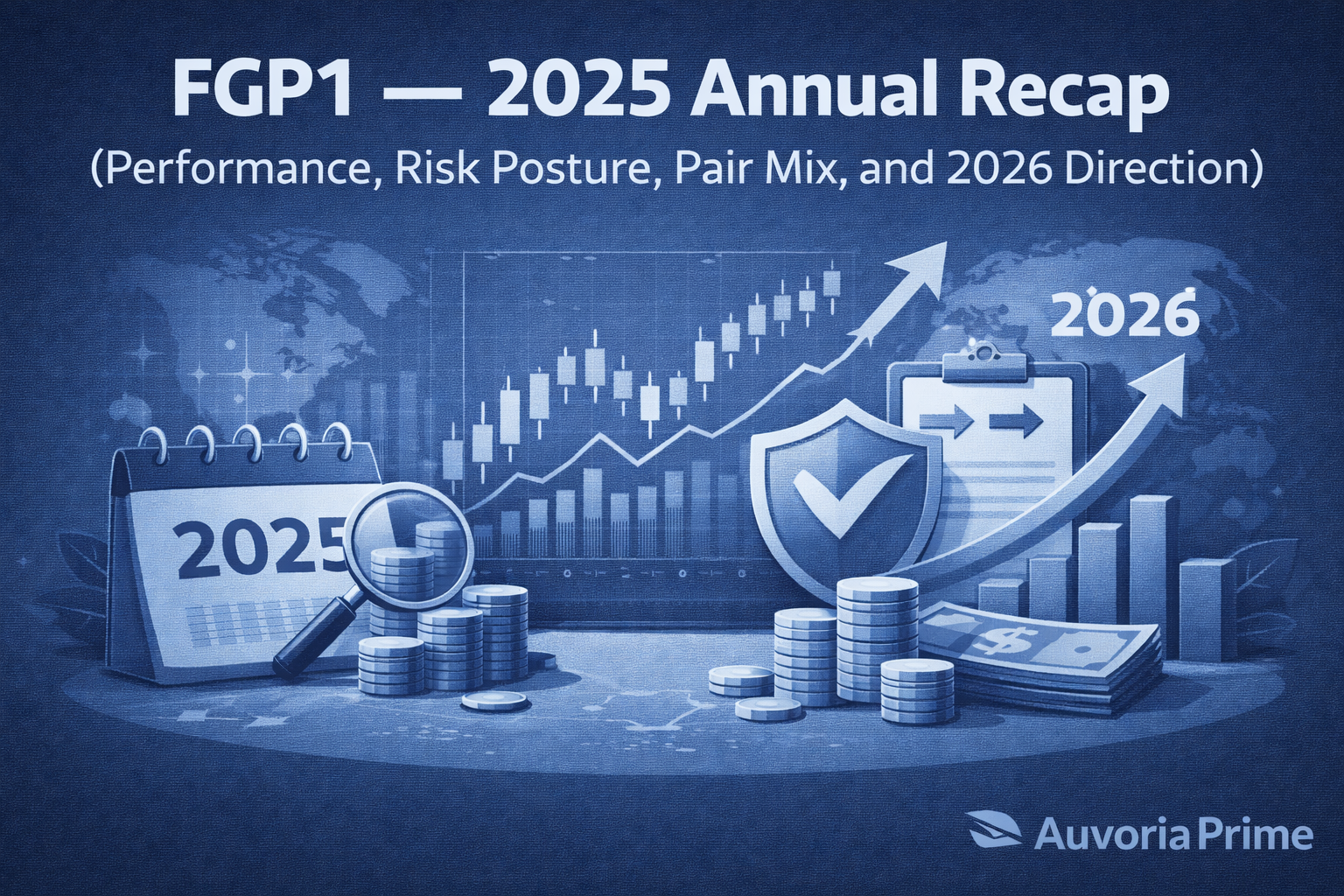

1) 2025 Performance Snapshot
FGP1 produced a 12-for-12 green year, finishing 2025 at an estimated +35.14% compounded return based on the monthly gains shown.
Key facts (2025)
- Compounded return: +35.14%
- Average month: ~+2.55%
- Best month: April +6.23%
- Lowest positive month: January +0.43%
Monthly gains (as shown)
Jan +0.43% | Feb +2.10% | Mar +0.88% | Apr +6.23% | May +2.40% | Jun +4.49% |
Jul +2.36% | Aug +3.41% | Sep +2.04% | Oct +2.38% | Nov +1.85% | Dec +2.05%
What this means for participants: the edge in 2025 was consistency and compounding, not dependence on one “home-run” month.
2) Market Context: Why the Risk Posture Mattered
2025 included multiple volatility pockets across FX and metals tied to macro policy expectations, shifting rate outlooks, and headline-driven repricing—conditions that commonly punish over-leveraged or under-filtered strategies. Market commentary going into 2026 explicitly highlights political and policy uncertainty (including expectations for Trump administration policies) as a key driver of volatility in rates and risk assets.
FGP1’s core differentiator over the year was straightforward: risk-managed execution that remained stable enough to keep compounding working through changing conditions.
3) Pairs Traded and What the 2025 Analytics Signal
Across the monthly analytics, FGP1 rotated within a defined universe:
- EURUSD, GBPUSD, NZDUSD, USDCAD, AUDUSD, USDCHF, EURAUD
- XAUUSD (Gold) appeared early in the year (notably January)
Reward: Risk themes (high-level)
- EURUSD showed outsized efficiency in multiple months, including a major reading in December (Reward:Risk 21.24).
- NZDUSD delivered strong Reward:Risk readings in several mid-year months, but notably turned negative in December (-0.35)—useful for future regime filtering.
- GBPUSD was regime-dependent but productive in key windows (e.g., strong Reward:Risk in November 6.87, and solid contribution in December with 2.88).
- USDCAD was heavily featured early in the year; strong in some conditions, not uniformly dominant across the year.
Holding time (risk lever)
A crucial 2025 observation is holding-time expansion in December, particularly on USDCHF (extending out toward the far end of the chart’s multi-week axis). Longer holds can be valid, but they increase gap exposure and require stricter governance (filters, exposure caps, and time-in-trade oversight).
4) Q4 Pair Highlights (Integrated)
November 2025
- Monthly: +1.85%
- Reward:Risk leaders: AUDUSD 8.95, GBPUSD 6.87, NZDUSD 2.24
- Notable underperformer: EURUSD -0.28
- Exposure was diversified, led by GBPUSD (26.5%) and AUDUSD (20.5%)
December 2025
- Monthly: +2.05%
- Reward:Risk leaders: EURUSD 21.24, GBPUSD 2.88, AUDUSD 1.09
- Negative Reward:Risk: EURAUD -0.45, NZDUSD -0.35, USDCHF -0.80
- Exposure leaned heavily into EURAUD (27.2%), GBPUSD (26.1%), AUDUSD (25.0%)
- Holding time expanded materially versus most prior months (especially USDCHF)
Why this matters: Q4 supports a 2026 optimization theme—keep what repeatedly shows strong risk efficiency, and apply conditional activation/filters where Reward:Risk turns negative or holding-time risk increases.

6) How 2025 Compared to Conventional Investment Alternatives
To give participants a familiar benchmark, here is how FGP1’s +35.14% (2025) compares to common “traditional” alternatives in the same general period:
Cash equivalents (low volatility, low return ceiling)
- High-yield savings accounts (HYSA): top advertised APYs around ~4%–5% in the market around year-end 2025 / early 2026.
- Money market funds: widely used cash-management vehicles; examples at year-end 2025 show ~3.4%–3.7% 7-day yields (varies by fund, fees, and timing).
Comparison: FGP1’s 2025 return exceeded cash-equivalent yields, but with meaningfully different risk characteristics (trading risk vs. deposit/cash-fund risk).
Broad equity index exposure (higher volatility, long-run growth focus)
- S&P 500: 2025 “1-year return” shown around ~16.39% (index reporting). (S&P Global)
- Vanguard S&P 500 ETF (VOO): Vanguard reports ~17.82% YTD as of 12/31/2025. (Vanguard)
Comparison: FGP1 outperformed broad U.S. equity benchmarks in 2025 on headline return; however, equities carry their own drawdown profile and can materially differ year to year.
Core bonds (typically lower volatility than equities)
- Bloomberg U.S. Aggregate Bond Index: reported ~7.30% 1-year return around year-end 2025.
- Vanguard Total Bond Market ETF (BND): Vanguard reports ~7.11% YTD (NAV) as of 12/31/2025.
Comparison: FGP1’s 2025 return exceeded core bond benchmarks, again with a different risk model (trading strategy risk vs. rate/credit risk).
Compliance-safe framing for participants: Conventional products (cash, bonds, index funds) are widely used because they are simple and regulated within well-understood structures. FGP1’s goal is not to replace those tools, but to offer a disciplined, defense-first trading approach that seeks consistent compounding while acknowledging materially different risks.
7) 2026 Direction (What We’re Doing With 2025 Data)
Based on the full 2025 analytics:
- Pair optimization / pair removal
- Reduce the basket toward pairs that repeatedly deliver favorable Reward:Risk.
- De-emphasize or conditionally activate pairs that show negative Reward:Risk in specific regimes.
- Stronger regime filters (especially for late-year conditions)
- December’s longer holding times and mixed Reward:Risk outcomes justify tighter controls.
- 2025 tick-data validation
- Running strategy validation on 2025 tick data as a dedicated regime sample is the correct next step to confirm robustness and reduce overfitting risk.
Disclaimer
This report is provided for informational and educational purposes only and does not constitute financial advice, investment advice, or an offer/solicitation. Trading foreign exchange and other leveraged instruments involves significant risk of loss and is not suitable for all participants. Past performance, backtests, and forward results are not indicative of future results. All performance figures referenced here are based on the analytics provided and may differ across brokers, execution conditions, spreads, slippage, liquidity, and account settings. Participants should consult a qualified professional and only risk capital they can afford to lose.
CFDs Meaning Trading: A Complete Guide to Understanding Contracts for
One term that frequently appears in online trading is CFDs. If you’ve searched for CFDs meaning trading, you’re likely looking…
FGP1 August 2026 Performance Overview
Geographic Restriction & Risk Notice FGP1 is geographically restricted and is not available to U.S. persons or residents. Trading involves substantial…

Best Robo Advisors: A Complete Guide to Automated Investing
Choosing how to invest has become easier than ever thanks to technology. One of the biggest innovations in recent years…

Best Day Trading App: What Traders Should Look for Before
Day trading has become more accessible than ever. With the rise of mobile technology, cloud-based platforms, and real-time market data,…
FGP1 July 2026 Performance Overview
Geographic Restriction & Risk Notice FGP1 is geographically restricted and is not available to U.S. persons or residents. Trading involves substantial…
London Session Forex Time: Everything Traders Need to Know About
The foreign exchange market operates 24 hours a day, five days a week. While trading is possible around the clock,…
