

Geographic Restriction & Risk Notice
FGP1 is geographically restricted and is not available to U.S. persons or residents. Trading involves substantial risk, including possible loss of principal. Past performance is not indicative of future results. This material is informational only and does not constitute investment advice, an offer, or a solicitation.
Why we publish monthly reports (and why “risk-first” matters)
Most trading performance content online is built to impress, not to inform. That usually means highlighting the best months, minimizing uncomfortable statistics, and using language that implies repeatability (“consistent,” “steady,” “safe,” etc.). That isn’t how serious risk management works.
Our goal with FGP1 monthly reporting is different: transparency, context, and discipline.
A single month’s return—good or bad—doesn’t tell you much on its own. It becomes useful only when you pair it with the rest of the picture:
- What level of drawdown was observed in the same reporting window?
- How many trades produced the result (and were they concentrated in one symbol or distributed)?
- What do the statistics suggest about variability and trade behavior?
- What’s the market environment, and how does it relate to the assets traded?
This February report is written with that framework in mind.
February 2026 headline result
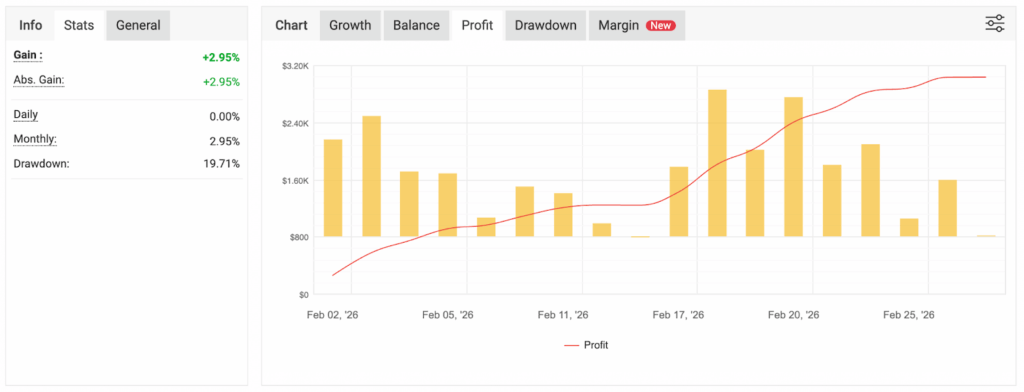
For February 2026, the Myfxbook views provided show a monthly performance of approximately ~+2.9%.
- The Myfxbook summary panel shows Monthly: 2.95% (and Gain/Abs. Gain +2.95%).
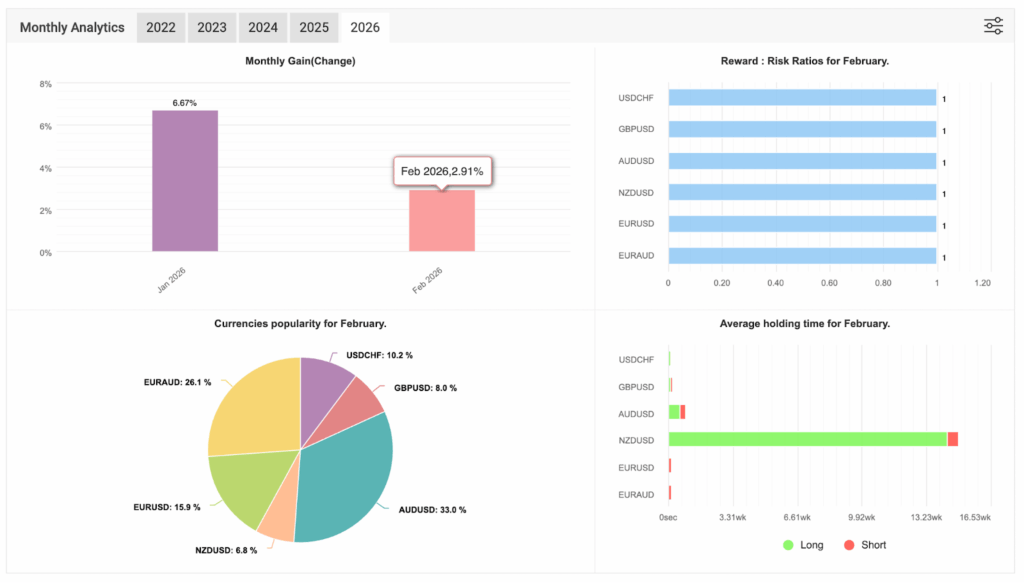
- The Monthly Analytics view shows Feb 2026: 2.91%.
Those values are close enough that the most accurate and honest headline is ~+2.9%, and in this report, we treat it as a single-month snapshot, not a forward projection.
Drawdown figure displayed: 19.76% (as shown on the same Myfxbook panel view).
It’s important to state this plainly: drawdown is not a footnote—it’s part of the cost of the return profile. This is why we publish both.
FXBlue Button for FGP1
February at a glance: key stats from the screenshots
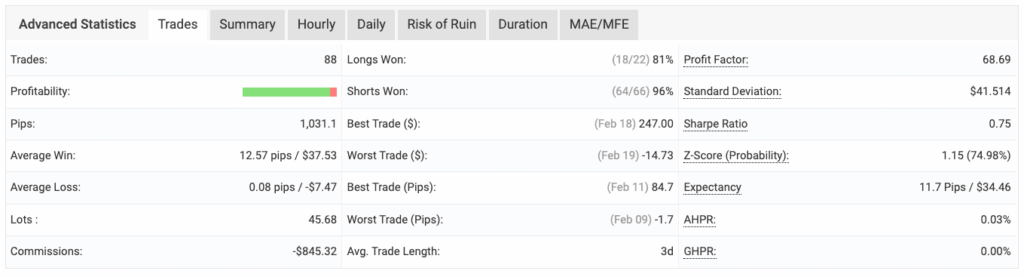
The Advanced Statistics summary view provided for February includes the following:
- Trades: 88
- Pips: 1,031.1
- Profit Factor: 68.69
- Sharpe Ratio: 0.75
- Expectancy: 11.7 pips / $34.46
- Best Trade: $247.00 (Feb 18)
- Worst Trade: -$14.73 (Feb 19)
- Average Trade Length: 3d
- Commissions: -$845.32
- Longs Won: 81% (18/22)
- Shorts Won: 96% (64/66)
A few notes about how to read these:
- Profit Factor can be eye-catching, but it’s still a month-specific statistic. It should never be interpreted as a guarantee of persistence.
- Sharpe Ratio is a risk-adjusted metric; even so, it is sensitive to time window and sample characteristics.
- Expectancy is one of the more helpful “process metrics,” but it also changes as regimes change.
- The month’s best/worst trade numbers help illustrate the spread of outcomes, but they do not predict future dispersion.
What we traded in February (and what dominated activity)
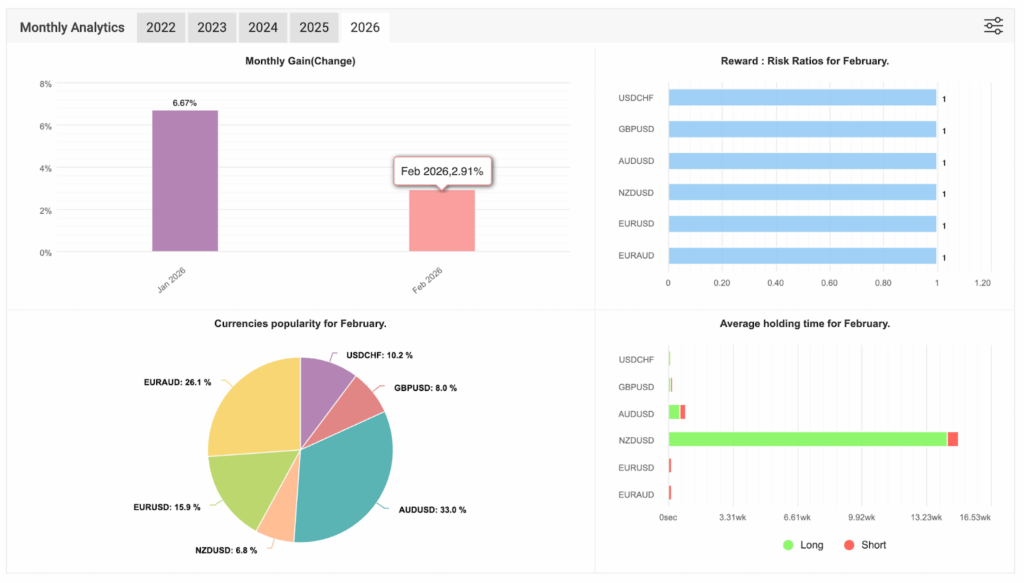
February trading activity was spread across a six-pair FX basket. Your Monthly Analytics “Currencies popularity” chart shows the activity distribution for the month as:
- AUDUSD: 33.0%
- EURAUD: 26.1%
- EURUSD: 15.9%
- USDCHF: 10.2%
- GBPUSD: 8.0%
- NZDUSD: 6.8%
From a risk perspective, this matters for two reasons:
1) Concentration risk
When a strategy is overly concentrated in one symbol, the month’s outcome can be largely dictated by that symbol’s specific microstructure, volatility regime, and correlation behavior.
In February, AUDUSD and EURAUD together represent nearly 60% of activity by that chart. That doesn’t mean the strategy is “dependent,” but it does mean those pairs likely exerted meaningful influence over the month’s experience.
2) Correlation and regime
Even when you trade multiple FX pairs, correlations can tighten during certain market regimes (risk-on/risk-off waves, central bank surprises, or USD-driven broad moves). When correlations tighten, “diversification” can shrink in real time.
That’s why we don’t just list symbols—we watch how they behave together.
Symbol-level contribution
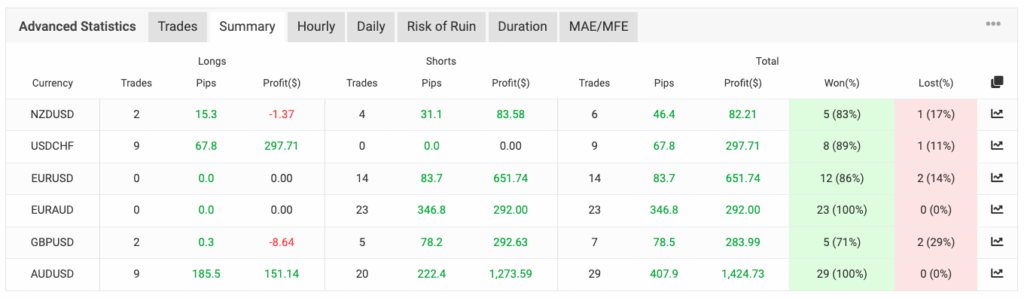
From the per-pair table you provided (showing total profit by currency pair), February’s profit contributions were:
- AUDUSD: $1,424.73
- EURUSD: $651.74
- USDCHF: $297.71
- EURAUD: $292.00
- GBPUSD: $283.99
- NZDUSD: $82.21
Two practical takeaways:
- AUDUSD was both the top activity share and the top profit contributor in the month’s table.
- The remainder of the basket contributed in a “supporting” role, which can be helpful when the goal is reducing reliance on a single symbol.
Also worth noting: the same table view shows very high win rates for some pairs in February (including 100% on the view shown for AUDUSD and EURAUD). That can happen in a month. The responsible interpretation is: that’s a month-specific outcome—not something to extrapolate.
Longs vs shorts: what the month suggests about directional behavior
Your Advanced Statistics summary includes directional win rates:
- Longs won: 81% (18/22)
- Shorts won: 96% (64/66)
This is meaningful because it suggests February’s outcome leaned heavily on the strategy’s short-side behavior while still producing strong long-side outcomes.
However, directional win rate should always be interpreted carefully:
- A high short win rate in one month can occur because of the regime (trend, mean reversion conditions, volatility compression, etc.).
- The distribution of trade durations and the “shape” of winners/losers matters as much as the percentage itself.
- High win rate does not automatically mean low risk. If losses are rare but large, the risk profile can still be aggressive.
In this February set, the worst trade shown is -$14.73, which suggests that at least in the reported window, losses did not dominate the month’s P&L. But again: that does not guarantee the same shape in future months.
Time-in-market: average trade length and duration distribution
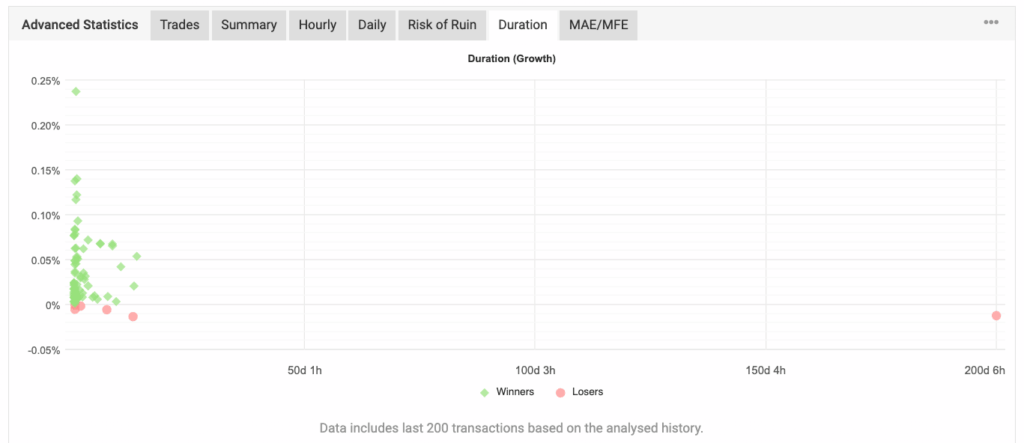
The Advanced Statistics summary shows an average trade length of ~3 days. Additionally, the Duration (Growth) visualization suggests a cluster of trades in shorter-to-moderate holding windows, with a few outliers.
Why this matters:
- Duration is exposure. Time held is time exposed to volatility, gaps, and correlated moves.
- Strategies with very long holding times can be more vulnerable to macro shocks.
- Strategies with very short holding times can be more sensitive to spreads, execution quality, and micro-volatility.
FGP1’s February duration characteristics (as shown) point to a profile that is not strictly ultra-short scalping and not purely long-term swing—more of a short-to-moderate holding approach, based on the month’s reporting.
Hourly and daily behavior: what we can—and can’t—conclude
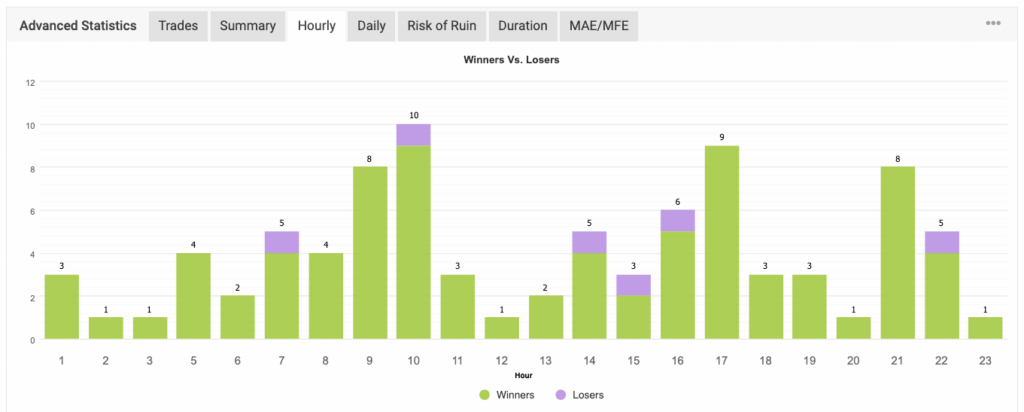
You included Hourly and Daily charts showing winners vs losers. These visuals can help spot whether performance is heavily concentrated in a specific session or day pattern.
The correct way to use these charts is diagnostic, not predictive:
- If a strategy only performs during one narrow hour band, that can be a fragility risk.
- If losses cluster around certain session transitions (rollover, liquidity shifts), it may indicate a vulnerability.
- If outcomes are broadly distributed, it can indicate a more robust exposure set—though it still depends on the underlying logic.
Because these charts are month-specific, we treat them as “what happened,” not “what will happen.”
Risk of Ruin: helpful model output, not a promise

Your Risk of Ruin panel shows a Probability of Loss <0.01% across multiple loss-size thresholds in that view, along with very large “consecutive losing trades” numbers at those thresholds.
A responsible interpretation:
- Risk of ruin calculations are model-driven outputs based on historical trade behavior and assumptions about independence and distribution.
- They can be useful as a reference to compare configurations or regimes.
- They are not a guarantee against losses, drawdowns, or adverse conditions.
Markets can change faster than models. “Low probability” is not “impossible,” and this is why we always anchor the conversation to drawdown tolerance and disciplined reporting.
Equity and growth chart: why we track both
Your Myfxbook chart includes both a growth line and equity growth behavior. Even without narrating every swing, the reason this matters is simple:
- Balance typically reflects closed trades.
- Equity includes open trade fluctuations.
If equity consistently diverges from balance, it can signal that open trade volatility is a major part of the experience. If equity and balance track closely, it can suggest tighter exposure control—though that depends heavily on strategy design.
For February, we use this chart as a visual confirmation of the month’s progression and volatility footprint, not as a marketing “proof.”
Comparing trading results to traditional investments (the compliant way)
People often ask: “How does ~+2.9% in a month compare to savings, CDs, bonds, or index funds?”
The compliant and responsible answer is: they are different instruments with different risk profiles, and the comparison should focus on volatility and drawdown tolerance—not just the return number.
Savings accounts / CDs
- Designed for capital preservation and liquidity (depending on terms).
- Typically lower volatility than trading strategies.
- Returns are often bounded by prevailing interest rate conditions and terms.
Bonds
- Can be lower volatility than equities in many environments, but not always.
- Subject to duration risk, credit risk, inflation expectations, and policy surprises.
- Can experience meaningful drawdowns in rising rate regimes.
Equity index funds
- Historically growth-oriented, but can experience deep drawdowns during recessions, crisis periods, or valuation resets.
- Returns are uncertain over short windows and heavily path-dependent.
Active FX trading strategies
- Can express returns under varied conditions, but carry meaningful risks including drawdowns, regime shifts, and periods of underperformance.
- Can be sensitive to market microstructure, volatility, and correlation behavior.
Bottom line: FGP1 is not a replacement for traditional tools. It is a different exposure profile. Anyone evaluating a trading strategy should do so with a sober understanding that losses are possible and outcomes vary.
What we want readers to take away from February
If you only remember three things from this report, make it these:
- February was approximately +2.9% based on the Myfxbook views provided, but it is one month—not a forecast.
- Risk context is part of the story. The drawdown figure displayed (19.76%) matters, and we publish it for transparency.
- The month’s activity was diversified across six FX pairs, with AUDUSD and EURAUD leading activity share and AUDUSD leading profit contribution in the month’s table view.
This is the kind of reporting cadence we prefer: consistent, measured, and grounded in what the data shows—not in what marketing wants to imply.
Compliance & Geographic Restriction
This content is for informational purposes only and does not constitute investment advice, an offer, or a solicitation. Trading involves substantial risk and may result in loss of capital. Past performance is not indicative of future results, and no guarantees are made. Participation is geographically restricted and not available to U.S. persons/residents, and may be restricted in other jurisdictions where such activity is prohibited.

FGP1 September 2026 Performance Overview
Geographic Restriction & Risk Notice FGP1 is geographically restricted and is not available to U.S. persons or residents. Trading involves substantial…

Australian Dollar (AUD): Why It Strengthened in 2026 and What
The Australian dollar (AUD) has attracted considerable attention in the foreign exchange market throughout 2026. After experiencing a notable appreciation…

Quantitative Trading: A Complete Guide to Data-Driven Trading Strategies
Quantitative trading has changed the way many traders approach financial markets. Instead of making every decision based on instinct, chart…

CFDs Meaning Trading: A Complete Guide to Understanding Contracts for
One term that frequently appears in online trading is CFDs. If you’ve searched for CFDs meaning trading, you’re likely looking…
FGP1 August 2026 Performance Overview
Geographic Restriction & Risk Notice FGP1 is geographically restricted and is not available to U.S. persons or residents. Trading involves substantial…

Best Robo Advisors: A Complete Guide to Automated Investing
Choosing how to invest has become easier than ever thanks to technology. One of the biggest innovations in recent years…
